4.5 star

Review: The Paris Apartment by Lucy Foley

Jess needs a fresh start. She’s broke and alone, and she’s just left her job under less than ideal circumstances. Her half-brother Ben didn’t sound thrilled when she asked if she could crash with him for a bit, but he didn’t say no, and surely everything will look better from Paris. Only when she shows up – to find a very nice apartment, could Ben really have afforded this? – he’s not there.

The longer Ben stays missing, the more Jess starts to dig into her brother’s situation, and the more questions she has. Ben’s neighbors are an eclectic bunch, and not particularly friendly. Jess may have come to Paris to escape her past, but it’s starting to look like it’s Ben’s future that’s in question.

The socialite – The nice guy – The alcoholic – The girl on the verge – The concierge

Everyone’s a neighbor. Everyone’s a suspect. And everyone knows something they’re not telling.


I always love a good closed-room mystery, and this was really no exception. I’m generally a fan of Lucy Foley’s work, and this one didn’t disappoint me—though I have heard mixed reviews from others.

The Paris Apartment takes place in…you guessed it, a fancy apartment in Paris. The neighbours we meet are certainly something, and above all, of course, suspicious. Just what is going on with these weird neighbours? Each one has their own story to hide, and it all seems to have something to do with Ben, the protagonist’s half-brother, who is missing from the very start. What is the connection between all the neighbours, including the concierge who always watches out front?

The characters were all fantastic. Each was so suspicious, mostly so deplorable and annoying that a reader’s natural biases start to come up, which is a fantastic play on tropes by the author. There were the more foil characters, and then there were the more complex characters that we see play out. However, it does not become immediately obvious who the perpetrator is because of who was focused on more. There was an appropriate level of character development and although it wasn’t a major factor in the development of the mystery, there was enough to satisfy the readers so that we could understand their motives and goals.

I personally felt the plot was excellent. There were so many twists and turns, some obvious, some not, but all equally surprising anyway. Having read many mysteries and thrillers, at this point, most things aren’t a straight-up surprise. But, it also means that the author is able to play on the “obvious” plot lines that I expect with their signals and red herrings. I also enjoy her writing style. Foley likes to do a lot of these short, parallel chapters to build effects and suspense, and that it something I enjoyed both in The Guest List and in this one. Just when I thought there was a reveal and all was solved, there was always so much more. This helped to create drive so that I did not get bored when I figured out one of the surprises in the book. I certainly didn’t see the final few surprises coming, and I had to keep re-wrapping my mind around it. There was one chapter that I think could have been re-ordered for a little bit more dramatic effect at the end but overall I thought it was really excellent how everything built up to the climax and denouement. I definitely didn’t see it coming fully.

Overall the mystery and thriller elements were good, with the slightly unreliable protagonist (but not too much), and the way every character seems shady, and how you just cannot trust anyone you meet. The result is a very exciting story which I plowed through quite quickly. The ending was also pretty exciting, and like I said, I didn’t really see it coming fully so I was pretty genuinely satisfied. I don’t expect endings to be surprising often, but rather I look more for the execution of the ending and how the author ties up certain loose ends (or doesn’t tie up certain loose ends) for a satisfying ending. I definitely enjoyed this one.

Overall Recommendations

The Paris Apartment is a typical closed-room mystery that takes place in a rich apartment. Jess moves to her half-brother’s beautiful apartment, although it seems like he has gone missing and is unable to receive her. So, of course, it is up to Jess to speak with all the neighbours and any contacts Ben might have had in order to figure out where he is. The more she looks, the more locked doors she finds—which means she’s getting closer, right? Just what is the mystery of this Paris apartment, and what lurks behind closed doors? Fast-paced, thrilling, and exciting, this one is sure to be for you if you like a good closed-room mystery novel!
2.5 star, YA

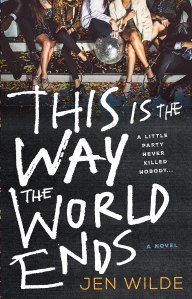
ARC Review: This is the Way the World Ends by Jen Wilde

You are cordially invited to spend one fateful night surviving an elite private school’s epic masquerade ball

As an autistic scholarship student at the prestigious Webber Academy in New York City, Waverly is used to masking to fit in—in more ways than one. While her classmates are the children of the one percent, Waverly is getting by on tutoring gigs and the generosity of the school’s charming and enigmatic dean. So when her tutoring student and resident “it girl” asks Waverly to attend the school’s annual fundraising Masquerade disguised as her, Waverly jumps at the chance—especially once she finds out that Ash, the dean’s daughter and her secret ex-girlfriend, will be there.

The Masquerade is everything Waverly dreamed of, complete with extravagant gowns, wealthy parents writing checks, and flowing champagne. Most importantly, there’s Ash. All Waverly wants to do is shed her mask and be with her, but the evening takes a sinister turn when Waverly stumbles into a secret meeting between the dean and the school’s top donors—and witnesses a brutal murder. This gala is harboring far more malevolent plots than just opening parents’ pocketbooks. Before she can escape or contact the authorities, a mysterious global blackout puts the entire party on lockdown. Waverly’s fairy tale has turned into a nightmare, and she, Ash, and her friends must navigate through a dizzying maze of freight elevators, secret passageways, and back rooms if they’re going to survive the night.

And even if they manage to escape the Masquerade, with technology wiped out all over the planet, what kind of world will they find waiting for them beyond the doors?


Overall Recommendation:

This is the Way the World Ends delivers on the diversity front in its characters but lacks the emotional connection to them. Between certain flashbacks and a plot about the world literally ending, there wasn’t enough time focused on any singular thing. There was a lot of potential but perhaps didn’t come through in a way I had anticipated while rooting for Waverly and co.

**This is the Way the World Ends comes out May 9, 2023**

Thank you to the publisher and Netgalley for this copy in exchange for an honest review

This book is definitely reminiscent of the dystopian era of YA, although it starts off in a world similar to ours. You know going into the book that things aren’t as they seem, and the world may be on the brink of big changes that will impact everyone in a devastating manner. How this happens though? Now that’s the mystery, and it does unfold in an intriguing way.

Set in a prestigious New York school, we follow Waverly, one of few students who attend based on scholarship and merit instead of wealth and connections. For the most part, I liked her as a protagonist. She’s unique and stands out among the YA crowd full of heroines that all seem so…one noted. She’s autistic and deals with the world in a slightly different way than others. But that doesn’t necessarily define her, just a fact that explains how her POV makes sense.

There’s also a heavy emphasis in chronic illness among the secondary characters. From MS flares to the need for a cane with mobility, diversity is most definitely present. While it’s tempting to feel like the author just wants to add “diverse characters” into the story, I don’t feel that is the case here. These aren’t just token characters to check off a box and feel good about yourself. Their disabilities or health struggles are a part of who they are and play more of a role in the story than an adjective to describe a person.

That being said, I struggled the most with this story when it came to really connecting with the characters. They seem great and all, but why should I care? I know, it sounds harsh, but a part of me felt very disconnected from them, which isn’t great when these characters are on the run and trying to escape pending doom and death.

What the book excelled at more was laying out the end of the world plot. It felt like a quick read at times because I was anticipating with Waverly the puzzle pieces we needed to put together to understand what’s happening. The end of the world hadn’t happened yet, unlike most dystopians that already drop you in a devastated world, so it was cool seeing the transition.

Unfortunately, the plot dragged only in its flashback scenes. They’re there to add context for Waverly’s relationship with her ex, Ash. I liked Ash well enough but I couldn’t determine whether I was rooting for their present relationship or not from what little information we are presented with about her. Most of the happy parts of their relationship occurred in the past so I never got to truly feel them falling in love. In fact, the romance almost deterred some of the action in the story with the page time it was given.

Without giving away anything, I’ll say that I’m not sure how I feel about the ending. It both felt like the appropriate place to leave it while also making me wish for more. That may be a good indicator for a book. It makes you both want more and somewhat satisfied with the direction it did go in. For a debut novel, This is the Way the World Ends had some bumps but it also had some things I enjoyed for a quick read.

discussion

Let’s Talk Bookish – Long or Short Series

Aria @ Book Nook Bits is the new host for Let’s Talk Bookish! If you aren’t following her yet, good check out her blog and give her a follow!

May 5: Long Series vs. Short Series (Hannah @ Hannah’s Library)

Prompts: What is the ideal number of books in a series? Does it depend on the genre? Do you prefer longer series with five or more books, or shorter series with less than that? Have you ever read a duology and if so, did you wish it was longer, or was two books enough for the story?

Welcome to another week of LTB here at DTRH, everyone! It is now May, and time is flying rapidly by. Unfortunately it is not quite spring yet where I am, but I hope it’s nicer where you all are! Today’s topic is a new one I don’t think I’ve seen before, so I’m super glad for Hannah’s suggestion. Without further ado, let’s discuss!

The first prompt is certainly quite a loaded question. The ideal number of books in a series is: just the right amount. But of course, that is not really an answer. I think generally, two or three books in a series is great. I think when it gets to four, it can be a little bit exhausting, unless it’s really good—but even then, it’s really difficult to have four really great books. I think of Stalking Jack the Ripper series as a decent four-book series, but I think generally even with two- or three-book series, it can be really hard to keep your audience.

Number of books in a series definitely does correlate with genre. In my mind, it would be unsurprising that the fantasy books often have two or three books to their series. But I think it makes sense, since world-building generally takes time, and the more that is explored, the more words that are needed. The genres I read a lot of, which are thrillers and mysteries, definitely doesn’t lend itself it sequels.

I think I generally prefer duologies and trilogies. Instantly the ones that come to mind are: Six of Crows and Caraval, respectively. It just allows for a lot of exploration of the different characters and the world-building. Of course, this is by no means necessary, but if a world is developed well enough and left open in the first book, I wouldn’t be surprised if there were readers and fans who would want more of it. That’s certainly how I feel about some books, and that is why we all cry out for sequels from time to time, right?

I rarely ever read anything with five books or more. Harry Potter is the main one that comes to mind, and other ones that I read as a child. Nowadays, it often just feels like such a big commitment to even commit to a book or two, I can’t remember what it’s like to read book after book in the same series! Because of the genres I read, I often only read standalones, and I generally prefer them, just so that I don’t feel the pressure of reading a sequel. But that being said, nothing wrong with a good sequel if the first book is just that good.

I think as long as the author has in mind that a book is complete after two or three books, it never feels too short. Of course, often I might want to see more of a character, or more of a particular world, or more of the mechanics of the magic involved, but these are just things that are also sometimes best left to the imagination as well. I think it’s always hard to say whether a series is too short or too long objectively, just because it really depends what piqued the reader’s interest in the first place. Of course, if you’re into the characters and their development, more books on world-building may not satisfy your thirst. So it really all depends. In general, I don’t think a duology is too short, though!