4 star, YA

ARC Review: This Place is Still Beautiful by XiXi Tian

Two sisters. A shocking racist incident. The summer that will change both of their lives forever. 

Despite having had near-identical upbringings, sisters Annalie and Margaret agree on only one thing: that they have nothing in common. Nineteen-year-old Margaret is driven, ambitious, and keenly aware of social justice issues. She couldn’t wait to leave their oppressive small-town home and take flight in New York. Meanwhile sweet, popular, seventeen-year-old Annalie couldn’t think of anything worse – she loves their town, and feels safe coasting along in its confines.

That is, until she arrives home one day to find a gut-punching racial slur painted on their garage door.

Outraged, Margaret flies home, expecting to find her family up in arms. Instead, she’s amazed to hear they want to forget about it. Their mom is worried about what it might stir up, and Annalie just wants to have a ‘normal’ summer – which Margaret is determined to ruin, apparently.

Back under each other’s skins, things between Margaret and Annalie get steadily worse – and not even the distraction of first love (for Annalie), or lost love (for Margaret) can bring them together.

Until finally, a crushing secret threatens to tear them apart forever.


**This Place is Still Beautiful comes out June 7, 2022**

Thank you Edelweiss and the publisher for this copy in exchange for an honest review.

There’s so much I can say about This Place is Still Beautiful but I’m not sure my rambling will do it justice. This is such a gorgeous story about sisterhood and dealing with racism in different ways as an Asian growing up in America.

Older sister Margaret and Annalie are half Chinese living in a town with very few visible minorities. Near the start of the story, we jump right into the heart of the plot: someone wrote a horrible racist slur on their home. That then brings the question that both sisters have to digest and wrestle with for the rest of the story – what would you do in the aftermath of such a brutal and directed attack from people who could be your neighbors, friends or coworkers?

The girls go about it in two different ways, which I very much appreciate the author taking the time to explore. Annalie wants to forget and move on from the whole incident, and I, as an Asian Canadian, feel that would be a big struggle for me too if this were to happen to me. Obviously one would want to seek justice and retribution for such a wrong done to them. But it’s another thing to be the face in the fight against racism.

And that’s exactly what Margaret does. She fights for what’s been done to their family, moving back home even though she had left town for college. While Annalie feels her sister is victimizing them, Margaret is taking control of a situation that wasn’t their choice to spread awareness and teach others this is NOT acceptable.

Reading this, it makes me reflect a lot too. Which sister would I be more like? I definitely liked Margaret’s side a lot more, especially when both Annalie and their mother wanted to pretend nothing happened and to not pursue more because no one would do anything about it. However, I understood why they would feel that way and it’s not such an easy answer if I were in their shoes.

While this aspect on racism I felt was fleshed out very well, there’s more to this story than just this. It’s really all about the sisterhood and family dynamic. Margaret and Annalie’s relationship is so fraught with tension and the inability to understand one another from their opposing viewpoints and personalities. To add to this dynamic is the typical Asian mother, but one who had to raise her daughters alone when her white husband walked out and left them all many years ago. The racism plot line surely takes up most of the story, but what connects it all is this deep exploration of family in an Asian household.

I also really loved the romance brewing in the background for Margaret and Annalie to kind of give some lighter reprieve around the heavier topics. Rajiv’s relationship with Margaret was my favourite. There was history there in this second chance love trope and I loved how it re-grew and matured in some way through the hardships she was facing.

I wasn’t sure going into this book how I’d feel reading about Asian hate and racism. It felt a little too close to home and personal, especially with the rise of anti-Asian views in the aftermath of the pandemic. But like XiXi mentioned in her author’s note, we may not intend to talk about it yet perhaps it’s exactly what we need to do instead of avoiding the very real problem at hand.

So that’s what I’m doing here. Please go read this book. It’s more than I anticipated and it’s worth reading regardless if you’re Asian or not.

Overall Recommendation:

This Place is Still Beautiful demonstrates how good storytelling can create such powerful messages that stays with readers. In the aftermath of an anti-Asian attack, sisters Annalie and Margaret explore what it means to be victims of racism as Asian women. I loved the honest struggle and reflection of what I’m sure Asians do feel and face unfortunately in today’s society at times. The interweaving of their specific family dynamic made the story all the more compelling as they individually and collectively grapple with the harm one action can leave behind. It’s a must read for sure.


4.5 star, YA

Review: You’ve Reached Sam by Dustin Thao

Seventeen-year-old Julie has her future all planned out—move out of her small town with her boyfriend Sam, attend college in the city, spend a summer in Japan. But then Sam dies. And everything changes.

Heartbroken, Julie skips his funeral, throws out his things, and tries everything to forget him and the tragic way he died. But a message Sam left behind in her yearbook forces back memories. Desperate to hear his voice one more time, Julie calls Sam’s cellphone just to listen to his voicemail.

And Sam picks up the phone.

In a miraculous turn of events, Julie’s been given a second chance at goodbye. The connection is temporary. But hearing Sam’s voice makes her fall for him all over again, and with each call it becomes harder to let him go. However, keeping her otherworldly calls with Sam a secret isn’t easy, especially when Julie witnesses the suffering Sam’s family is going through. Unable to stand by the sidelines and watch their shared loved ones in pain, Julie is torn between spilling the truth about her calls with Sam and risking their connection and losing him forever.


Bring out all those tissues, because I was completely right and You’ve Reached Sam jerked those tear ducts. HARD.

I have absolutely no words to use to describe this beautiful story. It made me cry (during work of all places!) and my heart ache for Sam and Julie.

This is a story about grief. But it is so much more than just what that word may imply. When Sam died tragically, Julie was left with a world that was devoid of the one person she was literally planning her future with. On the brink of high school graduation, what does one do?

In a series of flashbacks that presented as Julie’s dreams mixed with memories, we get to see Sam and Julie’s story from the first moment they met and all the little moments that made up their relationship. I loved this part because it made us understand who they each were, but also how they were together. And of course, it made me fall in love with Sam and their relationship even more.

Julie’s first reaction to handling grief was to cut everything out of her life that brought memories of Sam. That meant his clothes, his presents for her, everything. Some of it may have come with feelings of guilt for how Sam ended up dying, but it definitely was different from how the others in Sam’s circle were dealing with his death.

And that is ultimately a big thing explored here: everyone handles their grief differently. But that doesn’t mean they each have to be isolated in finding their way back to some semblance of living.

I love how it explored Sam’s closest relationships and how their relationship with one another changed and evolved after such a tragedy. And a tragedy this sure was because he was so young, he had barely lived out his dreams yet.

But back to the heart of the story. This is about Julie’s connection with Sam. And in some magical way, they were able to connect from the beyond and be able to still talk to each other. This is what made the story special, and also super heartbreaking. Because we all know it – this can’t possibly last forever. Julie will have to learn to let him go at some point.

The prose was beautiful. I loved Sam and Julie’s conversations so much. I loved seeing how she struggled with doing things in her life that felt like moving on in some miniscule way but only to fall away from it because of her still-present connection with Sam. Their relationship wasn’t always sunshine and rainbows, as it wouldn’t realistically be, but these were two people who loved one another deeply and made my cynical heart believe could’ve survived a high school romance into adulthood.

We were two parts of a song – he was the music and I was the words.

The ending almost broke me, in the best of ways, I suppose. I had to listen to this as an audiobook – I was so afraid I’d be crying so hard I wouldn’t be able to see the words. I needed to be able to get through the ending faster that would inevitably have me in a puddle of my own tears.

I won’t ruin the beauty of the conversations and the growth in Julie and those closest to Sam. I would want you to experience that firsthand yourself if this review has piqued your interest. I normally avoid books that I know will break my heart, but there was just something about this book that drew me in from the start.

I wondered why someone would want to intentionally experience [something that’d make you cry in a way you’ve never cried before]. I think I figured it out.

You want to feel something. Something meaningful and intense. You want to feel that thing in your heart and stomach. You want to be moved, to care about something or fall in love, you know….It makes you feel alive.

Dustin Thao, you’re a genius and your gut-wrenching story deservedly launched to #2 on the NYT bestseller list. I can’t wait to see what’s next.

Overall Recommendation:

You’ve Reached Sam is a heartbreaking story of loss and grief in a young life tragically gone too soon. Dealing with the aftermath of her boyfriend’s death, Julie struggles to move on when a magical connection through their phones allows them to communicate with each other, even from the beyond. Mixed with flashback dreams of their relationship and the present day haze of grief, this story will unlock those tear ducts as Julie inevitably needs to learn to let him go. Explorations of the different ways people handle grief, especially among those who were all near to the same loved one, was one of the highlights of this novel. But ultimately, Julie’s journey navigating life after Sam is one that was written with the most beautiful prose fitting for her story. I am overjoyed I found my way to this book, and you should definitely find your way here too.

3.5 star, YA

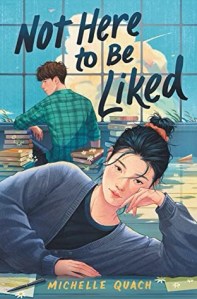
Review: Not Here to Be Liked by Michelle Quach

Emergency Contact meets Moxie in this cheeky and searing novel that unpacks just how complicated new love can get…when you fall for your enemy.

Eliza Quan is the perfect candidate for editor in chief of her school paper. That is, until ex-jock Len DiMartile decides on a whim to run against her. Suddenly her vast qualifications mean squat because inexperienced Len—who is tall, handsome, and male—just seems more like a leader.

When Eliza’s frustration spills out in a viral essay, she finds herself inspiring a feminist movement she never meant to start, caught between those who believe she’s a gender equality champion and others who think she’s simply crying misogyny.

Amid this growing tension, the school asks Eliza and Len to work side by side to demonstrate civility. But as they get to know one another, Eliza feels increasingly trapped by a horrifying realization—she just might be falling for the face of the patriarchy himself.


Not Here to Be Liked has left behind an impression on me that is both hard to eloquently write down and make coherent sense. I will try to organize it in some way, but please bear with me.

Firstly, I knew I was in love when I first turned on the audiobook and heard the first few chapters. Eliza Quan is a Vietnamese Chinese girl with parents who immigrated to North America as refugees from the aftermath of the Vietnam War. Her family has kept Chinese roots regardless of living in Vietnam for at least a generation so their household speaks a combination of Vietnamese and Cantonese. I’m just going to say that seeing (or rather, hearing) the Cantonese and every day references mentioned sent a delighted thrill of surprise through me. Like the following quote:

“Make sure you have enough rice to eat.”

Quan family motto

You have no idea how many times I grew up hearing this from my grandparents. It’s why I’m more of a noodle person as an adult because I had way too much rice as a child.

This made me feel like Eliza (and her family) was someone I intimately knew right away. Like she could’ve been a part of my family. Or my boyfriend’s family. It was so surreal to feel represented in fiction because I’m quite used to never seeing that. Even amidst the surge of Asian representation in YA, there was never any protagonist that quite hit the nail like Eliza did for me. (I won’t nitpick that the Cantonese spoken on the audiobook wasn’t quite without an accent, but it was still amazing!).

But aside from my personal connection to Eliza and her family, this book is about feminism. Or rather, the unwitting face of feminism Eliza becomes when someone released her rant – aka manifesto – about losing the school paper’s editor in chief vote. To a boy.

Maybe like most of us, we wouldn’t know what to do when we become the face of feminism among our peers. I sure wouldn’t. So all of a sudden, she’s launched into infamy, targeted by certain classmates with awful comments on social media and scrawled across her locker. Which in and of itself is sexist as the manifesto equally targets Len as the “face of patriarchy”. Why wouldn’t he get equal treatment against him, the target of the paper?

This exploration of “what makes one a feminist” and “how should a feminist act” was one I had to sit with for a while in writing this review. What does one immediately think of when we say “feminism”?

I’m a feminist, not a narcissist.

Eliza Quan

I do applaud Michelle Quach’s thoughts in the form of Eliza’s own internal questions and the different women she wrote about. Eliza definitely sat more in the middle, wanting to do her part, but not knowing if interacting with the enemy Len, made her a hypocrite and a terrible feminist. Her best friend Winona leaned more into the stereotype, for better or worse, that feminism sometimes bring to mind, wherein it’s more synonymous with anti-male. Meanwhile, the popular girl Serena that came into their lives in the aftermath of the manifesto embodied more of social action for something she stood for while not particularly looking or acting a certain way towards men. There was definitely growth in all three girls as they spearheaded the growing feminist movement in their school, but it was interesting noting the different directions each came at this same movement.

Quach also explored a little the impact of Asian cultures in wiring how women think through the experiences and stories Eliza’s mom told her, and the way she wanted her own daughter to behave. I appreciated that too because I can acknowledge it’s definitely there and prevalent in our societies even now. We do need more stories like this among POC communities, although I will also acknowledge it is a clash of Western and Eastern ways of thinking.

The romance, it seemed, fell somewhere behind all of this. It’s probably the only reason why I lowered my rating. I didn’t particularly feel the chemistry between Len and Eliza in their interactions. It could be because she wanted to hold onto her animosity towards him the whole time, but in getting to know Len, I came to realize he’s a pretty good guy and didn’t deserve the “face of the patriarchy” label. Of course, he still got off easy in the eyes of his peers (sexism, am I right?), but he wasn’t the villain the manifesto painted him out to be – or what I thought he’d be coming into this book.

Did I think it was a fun romance still? Sure, it was fine, but if a solid “enemies to lovers” trope is what’s bringing you here, you may need to rethink it a little. It’s definitely not the focus of this story.

All this to say, I reflected a lot as a result of reading this book about feminism and how I see myself, even, as a young woman in my society and among my peers. It’s made me think about how I can fight for equality, not superiority in any one sex, in my own life. And I think that is the point of this book, so it has done the job it’s set out to do.

Because feminism, contrary to popular belief, isn’t about hating on guys…It’s about all of us working toward equality, together.

Overall Recommendation:

Not Here to Be Liked was a wonderful reflection on feminism, especially in a young Asian girl where the culture largely dictated patriarchal values. I really enjoyed seeing the Asian influences and representation in this story, namely because Eliza spoke my language and has a very similar background with my own family. That being said, the book explores what it means to be a feminist in a way that is not condescending and looks at different angles through its various characters. While a romance is also present between Eliza and the “face of the patriarchy” Len, it is by far not the focus so the enemies to lovers storyline wasn’t fully fleshed out to satisfaction for romance lovers. Regardless of that one minor thing, I do think this is a worthwhile novel to pick up for its niche exploration of feminism in an Asian protagonist that sets it apart from other books currently out there. My thoughts may be a little all over the place, but this I know to be true at least.