4.5 star, YA

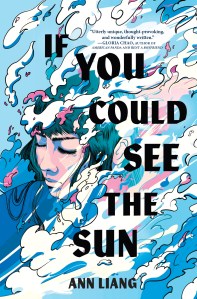
ARC Review: If You Could See the Sun by Ann Liang

Alice Sun has always felt invisible at her elite Beijing international boarding school, where she’s the only scholarship student among China’s most rich and influential teens. But then she starts uncontrollably turning invisible—actually invisible.

When her parents drop the news that they can no longer afford her tuition, even with the scholarship, Alice hatches a plan to monetize her strange new power—she’ll discover the scandalous secrets her classmates want to know, for a price.

But as the tasks escalate from petty scandals to actual crimes, Alice must decide if it’s worth losing her conscience—or even her life.

In this genre-bending YA debut, a Chinese American girl monetizes her strange new invisibility powers by discovering and selling her wealthy classmates’ most scandalous secrets.



**If You Could See the Sun comes out October 11, 2022**

Thank you Edelweiss and the publisher for this copy in exchange for an honest review.

Asian representation? Check. International boarding school locale? Check. A swoony academic rivals to lovers romance? Check. If You Could See the Sun checked off a LOT of boxes for me even before getting into it, but the actual story was a brilliant debut full of hijinks and personable characters to root for.

Alice goes to one of the most elite boarding schools in Beijing but that comes with a little problem. Her family is actually not that well off, and she only has half a scholarship to cover the cost of tuition. When it seems her family cannot afford to keep sending her to the one place where she feels she can be seen for who she is (re: almost the smartest overachiever), she gets desperate to maintain the crafted identity and reputation she took years to cultivate.

The idea of being unseen when Alice is surrounded by classmates from the top echelons of society, sons and daughters of actors and singers and CEOs, is one that I think we can all resonate with even if our situation is nowhere near as extreme. While others could be known for their money, charm, beauty or athleticism, Alice felt she really only had one thing: her intellect and ability to be the top 1 in her class. And in China, let me tell you, that is a whole different world and standard than perhaps what North American society is like, regardless that this is an international boarding school.

Of course, what irked her more was that her identity had to be shared with a rich boy who didn’t seem to need this reputation as much as she did. Enter Henry, who secretly is a cinnamon roll and probably had a crush on her the entire time. Personally, I think I liked that romantic set up even more because it’s obvious to ALL of us minus Alice that he didn’t see her as the enemy in the same way she built up their rivalry. The angst of waiting to see what could come of a partnership between them? Pure delight.

The pacing was good as it soon became evident that Alice’s fear of being unseen and unknown was building to explosive levels as her time at school was ticking towards a close. The slightly paranormal aspect of this story that imagines her feelings of invisibility manifesting as actual invisibility? I really enjoyed that because it was the perfect plot point to develop everything else. What do you get when you have a desperate girl wanting to make money with the uncanny ability to sneak around behind everyone’s literal back? A perfect money-making scheme.

As requests come in for Alice’s anonymous services that utilize her ability, it goes from innocuous to downright criminal. This is definitely more of a character-driven story than a plot one in the sense that the requests Alice accepts help build her character in good or bad ways. She was always a loner, friendly to everyone but not tight with anyone. Doing this brought to light secrets about her classmates as well as opened her eyes to who Henry could be to her if she wasn’t so angry with him all the time. While the plot could deviate a little depending on the task, it always felt relevant in terms of her growth trajectory.

Now, were there no complaints at all about the story? No, I can’t say it was perfect and I’ll outline why I had to dock off half a star.

The actual “magical” ability to turn her invisibility on or off wasn’t very clear. It just happened one day, and then there was no actual learning to control it. Even when Alice started using it for her services, she could never actively control it, but rather timed her activities to when she thought she was due to turn invisible based on past frequencies. Also, becoming visible again? Not controlled either. It’s a surprise she never got caught in the earlier tasks when she had no estimate for how long invisibility would last. While it’s not the biggest thing to nitpick on, the invisibility aspect is just a plot device and nothing more, and I feel it could’ve been utilized more as the metaphor it was. Does she get to keep this “ability” for the rest of her life or will it disappear if she learns to be seen for who she is in other aspects of her life? None of that is clear.

However, the bigger reason for not getting a full rating is the climactic request the synopsis hinted at. It gets SUPER morally grey with the decision Alice makes, and I personally do not condone how it all ended. I don’t know if it’s because of the fictional aspect, but I’m 100% sure in real life there would be more consequences. That’s not to say Alice’s growth was a villainous turn or anything. I do think it was a realistic arc for a desperate girl who wanted to her onto her one identifying characteristic. So kudos to Ann Liang for writing a complicated but realistic protagonist. Just some parts didn’t sit as well with me while I was reading it.

Last note before I end this review. While the setting is in Beijing and full of Chinese characters, whether foreign born or locals with high achieving families, this book brings lots of Asian representation to the table while not making it the biggest thing about it. I personally really liked that take. Don’t get me wrong. There are fantastic books that featured heavily on the Asian experience among the diaspora but this was a little different. Perhaps it’s because Alice is currently living in China, the land of her ancestors, so the focus can be on the Asian culture experience as it pertains to familial relationships and priorities without the major dissonance between two cultural identities. That is still relatable, or educational, but brings something slightly different to the table that I appreciated seeing.

Do I think this book is for everyone? Yes. Regardless if you’re Asian or not, this was a fun story of the lengths we may go to meet our own expectations and cultivated identities. It’s relatable to the human experience, but I loved the added bonus of having the Asian representation brought into focus. The romance was just the icing on top because who wouldn’t love a sweetheart like Henry with the manners of a far older gentleman? Please pick up this book when it comes out!

Overall Recommendation:

If You Could See the Sun tackles the overarching question: what lengths would you go to to be seen by others? Set in a gorgeous international boarding school in Beijing and filled with all sorts of cultural references, Alice gets to answer this question herself as she literally, not metaphorically, turns invisible one day. This embarks her on a journey of self-discovery and re-evaluated relationships, especially with her academic rival, Henry. The romance was superbly done with lots of the best kind of angst, and the pace of the story grows to a climax that hangs on the edge of a cliff. This book has something for romance lovers and those who love contemporaries with thought provoking themes. It is a truly great debut with excellent Asian representation as a bonus.

2.5 star, YA

ARC Review: The Weight of Blood by Tiffany D. Jackson

New York Times bestselling author Tiffany D. Jackson ramps up the horror and tackles America’s history and legacy of racism in this suspenseful YA novel following a biracial teenager as her Georgia high school hosts its first integrated prom. 

When Springville residents—at least the ones still alive—are questioned about what happened on prom night, they all have the same explanation . . . Maddy did it.

An outcast at her small-town Georgia high school, Madison Washington has always been a teasing target for bullies. And she’s dealt with it because she has more pressing problems to manage. Until the morning a surprise rainstorm reveals her most closely kept secret: Maddy is biracial. She has been passing for white her entire life at the behest of her fanatical white father, Thomas Washington.

After a viral bullying video pulls back the curtain on Springville High’s racist roots, student leaders come up with a plan to change their image: host the school’s first integrated prom as a show of unity. The popular white class president convinces her Black superstar quarterback boyfriend to ask Maddy to be his date, leaving Maddy wondering if it’s possible to have a normal life.

But some of her classmates aren’t done with her just yet. And what they don’t know is that Maddy still has another secret . . . one that will cost them all their lives.


**The Weight of Blood comes out September 6, 2022**

Thank you Edelweiss and the publisher for this copy in exchange for an honest review.

While The Weight of Blood was every bit the strong contender about race and the continued challenges the Black community faces in certain small towns with a history of segregation and racism, the execution of the mystery fell flat on so many levels. I know this is an unpopular opinion, but I’ll explain why I can’t give it a higher rating no matter how much I want to.

The premise of the story from the synopsis makes it sound like we follow Maddy, a girl who is half-Black but has been “lying” to the whole town and passing off as white her whole life. Unfortunately, her POV is only one of many that we follow and it dilutes the focus between too many people to thoroughly invest and enjoy any one of them. We follow Kenny, the love interest, who also happens be dating a popular white girl who is part of the group that bullied Maddy. But not only his POV, we get his girlfriend’s POV which was a rather interesting take as it made it harder to yearn for the main romance when I empathized with her situation the more I got to know her.

For the parts where we do get to see the situations Maddy lives through which we know somehow leads up to a Bloody Prom Night that left over a hundred dead in their small town, I was utterly enthralled in half amazement and disgust. Amazement at how she was raised and her fanatical father who put this narrative in her mind that being Black was wrong, but definite disgust at the treatment of her peers and the town overall towards her. I mean, they still had separate proms, like other ethnicities weren’t seen as equals to dance and celebrate together? Just disgusting behaviour, and I really hope not reflective of small towns in America.

I did think the social commentary on racism was a great place to launch much-needed discussions on this topic. In particular, I also liked the focus on her peers who didn’t throw any insults or directly did anything but nevertheless just stood by and allowed the ones who did get a free pass. Aren’t they as much at fault for what led up to the tragic Night?

Another interesting take was how the small Black community at school didn’t necessarily welcome her into their arms either. Was it because they thought she was ashamed of her Blackness and thus extends to those in the community? Was she not Black enough for them to at least acknowledge her as one of them? It was something that Kenny had to reflect on too as he had integrated well into the popular groups at school by, in a sense, pretending he was colour blind to the little “jokes” by his friends that really were microaggressions or harmful stereotypes.

I would’ve liked to have seen more focus on this topic but I suppose the point of the main premise is a thriller – the big Why everyone (or rather, the survivors) is trying to answer.

Don’t get me wrong, I love a good thriller, but the pacing was super off here. First, reminiscent to the popular book Sadie, there’s a present day podcast in interview style narrating what had happened a decade ago that is Maddy’s story. So the timeline is actually split with the present day parts looking to explain what led to the tragedy. While I like having the podcast style and making us feel just as confused and intrigued by Maddy’s story as the podcaster, it slows things down by cutting into any buildup. The multiple POVs with changing tensions (or different kinds of tension) doesn’t allow for extended buildup either. It’s just getting good – and then it cuts to present day or another person.

The romance was also marketed for this book in some ways, but I never felt any real chemistry between Kenny and Maddy. Yes, they both had to come to terms with their Blackness and what that means in who they want to be and how others may see them. But a connection on that struggle that doesn’t equate to instant attraction and undying love. Kenny did a complete 180 as he was still technically in a relationship with his girlfriend Wendy (whom we also get to really know) for most of the book. I honestly felt bad for Wendy at times even though she missed some cues that the relationship was not going where she hoped it would.

But, the one thing I think everyone loved given the strong Carrie vibes (is this considered a retelling?) but didn’t quite settle with me is the supernatural element to the story. I never read Carrie so I didn’t immediately make that connection with the synopsis so I most definitely wasn’t anticipating this supernatural narrative. In a way, it makes the premise less mysterious and therefore exciting for me. Now there’s a very plausible way that Bloody Prom Night ends up happening and there’s definitely plenty of motive for why on Maddy’s part. The only unknown is the exact sequence of events that led up to it. And the execution of that, as mentioned above, was at times convoluted and all over the place.

I wanted to love this book so badly. I haven’t been reading the reviews for it so I had no high expectations either beyond the premise. Unfortunately, however unpopular this is, The Weight of Blood was less thriller and more of a paranormal story with commentary on race and segregation in small town America.

Overall Recommendation:

The Weight of Blood doesn’t quite hit the nail as a thriller but it at least provides thoughtful reflection on Black identity in predominantly white small towns with a legacy of racism. I thoroughly enjoyed this aspect although it sickened me in places at the abuse our protagonist, Maddy, faced. However, the romance felt forced and the supernatural elements came as a surprise. If you enjoy social commentary on race with a huge sprinkling of paranormal activity, then this is for you! But otherwise, this isn’t what I’d say is a typical thriller and unfortunately not what I anticipated for my first Tiffany D. Jackson novel. It’s probably a case of “it’s me, not the book” so take what you will from this review.

1.5 star, adult

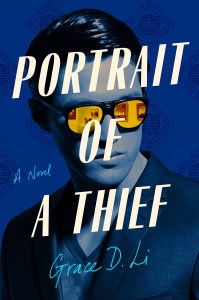
Review: Portrait of a Thief by Grace D. Li

History is told by the conquerors. Across the Western world, museums display the spoils of war, of conquest, of colonialism: priceless pieces of art looted from other countries, kept even now. 

Will Chen plans to steal them back.

A senior at Harvard, Will fits comfortably in his carefully curated roles: a perfect student, an art history major and sometimes artist, the eldest son who has always been his parents’ American Dream. But when a mysterious Chinese benefactor reaches out with an impossible—and illegal—job offer, Will finds himself something else as well: the leader of a heist to steal back five priceless Chinese sculptures, looted from Beijing centuries ago. 

His crew is every heist archetype one can imag­ine—or at least, the closest he can get. A con artist: Irene Chen, a public policy major at Duke who can talk her way out of anything. A thief: Daniel Liang, a premed student with steady hands just as capable of lockpicking as suturing. A getaway driver: Lily Wu, an engineering major who races cars in her free time. A hacker: Alex Huang, an MIT dropout turned Silicon Valley software engineer. Each member of his crew has their own complicated relationship with China and the identity they’ve cultivated as Chinese Americans, but when Will asks, none of them can turn him down. 

Because if they succeed? They earn fifty million dollars—and a chance to make history. But if they fail, it will mean not just the loss of everything they’ve dreamed for themselves but yet another thwarted at­tempt to take back what colonialism has stolen.

Equal parts beautiful, thoughtful, and thrilling, Portrait of a Thiefis a cultural heist and an examination of Chinese American identity, as well as a necessary cri­tique of the lingering effects of colonialism.

Ocean’s Eleven meets The Farewell in Portrait of a Thief, a lush, lyrical heist novel inspired by the true story of Chinese art vanishing from Western museums; about diaspora, the colonization of art, and the complexity of the Chinese American identity.


This is probably the saddest review I have to write because I had such high expectations for Portrait of a Thief. While I know this book may not have been written with every audience in mind, I feel I am one of those this was meant to excite. I feel I am one of those whose thoughts should hopefully matter as I navigate the complex feelings this book has sprung out of me.

I am Chinese Canadian and this book about the diaspora of Chinese immigrants across the Western world is, well, me.

Like most of the characters we follow in this heist crew, I was born in a Western society with only parental roots tying me back to my mother country. Yet my own complex relationship with China is not quite what any of these students feel. While many have praised the different voices or feelings each character wrestled with for their reasons to take on a heist job for China, I personally feel they were mostly one-note and the same. All their internal conflict, and oh boy was the book full of the same conflict for each character, was about escaping their prison-like futures weighed down with expectations and familial responsibilities, and not quite belonging to either country.

I can see that. I witness it sometimes in myself when I’m overseas and a person in China can immediately guess I am not from there simply from the way I dress and behave even if I speak Chinese to them. I also know that no matter I was born in Canada, people will see me and I will always be ‘other’ in some way, no matter that my English is perfect. But I don’t think it’s so simplified in the same way for every child of immigrants in this diaspora to feel so lost that it leads to the risk of a lifetime. I mean, the book wouldn’t exist if they hadn’t all felt drawn to such a risk worth taking, but it was hard to swallow after the 50th chapter mentioning the internal conflict in some form as they continued to take risk after risk to the point beyond recklessness for a country that also wasn’t quite fully theirs either.

Out of the 5 protagonists, I resonated most closely with Alex. Note aside, she has the same name as one of my good friends so that was a fun thing to see in a book. But it makes me question a little why I connected with her the most. Is it because she’s the only one who is Cantonese with a background from Hong Kong?

This is another thing the book doesn’t do well in. My family is from Hong Kong and it has a very different, even more complex, relationship with China. It’s probably another reason why I was so torn with the internal conflict of these students because it’s never addressed although Alex is so very much here. Even with her last name written in this way, Huang instead of Wong, she could’ve just been another Mandarin-speaking student and I wouldn’t have known the difference if her Cantonese family wasn’t mentioned. Why is that? It makes me wonder why nothing more was ever specified. Why include it then at all? It adds to the similarity of all these students which don’t represent the vast diaspora of Chinese immigrants. And I speak this from experience.

The story could’ve been saved with the levity that complex heists and creative escape plans might have brought with it. Yet this book is very much focused only on the identity struggle of the protagonists and not so much on the actual risks they are taking. It made the story drag as the heists were more an afterthought than any focus at all. I wouldn’t have minded it, in fact, I was warned that was the case. But I needed the levity for my own heart’s struggle and it just wasn’t there. I could barely swallow several chapters at a time because it was so heavy, and each student’s grief over their future and their identity was so dominant. The chapters aren’t even long yet I felt every one last half a lifetime.

The interpersonal relationships between all of them were also lacking. There were no feelings that jumped out of the page beyond what the words were telling me to feel. Will felt something that perhaps was more than his usual affair with Lily, but I never understood why that was. What made their interaction more special? Was it because they were planning a heist together with the added adrenaline thrown into the mix? The sapphic relationship also felt thrown out of left field because I never understood how it grew to love when all we’ve ever been given was the hate. It wasn’t even enemies-to-lovers done well.

And now we circle back to how I feel at the end of all of this. Portrait of a Thief was one of my most anticipated books, one I predicted I would love so much. It physically hurts that it’s not the case because I thought this book was written for someone like me. On a subject that was important and meant to be seen. Maybe it’s all too personal to me which is why it didn’t work out. Maybe I have too many connections to the history, to the countries, to the struggle for it to have ever worked out.

I’m left with questions I can only reflect to myself as I read each characters’ own questions. Would I have risked it all for a country that doesn’t fully accept me either? Would doing something as big as taking back power in the form of art be enough to make me belong? I’m not sure the answer is ever easy or so simple to make. It doesn’t even have to relate to heists and art, but simply this question: what lengths would I go to to feel like I belong in the freedom of all that I am?

And the fact that these college students wrestled so much with their futures to want to run from it, and very great futures at that with the privilege of attending the greatest universities in America that only some of us can ever hope to achieve, made me wonder if there’s something off with me for never having such a thought cross my mind with the expectations placed on the eldest child of an immigrant family who left it all behind for a greater chance in a different country.

Yes, this review is very introspective, and it’s not the usual take I have for books. But this book was written for me in many ways that most books are not. And perhaps the pain of not liking it at all is only amplified for that very reason.

Overall Recommendation:

Honestly, I can’t write a good TL;DR for Portrait of a Thief. If you want to know my thoughts, please read the entirety of it because it’s way too complex to put into a pithy summary. This is my history, this is my identity, and this book wrecked in me in a way I didn’t expect it to.