

4.5 star, YA

Review: The Space Between Here & Now by Sarah Suk

Perfect for fans of They Both Die at the End and You’ve Reached Sam, this gripping, atmospheric YA novel follows a teen with a mysterious condition that transports her to the past when she smells certain scents linked to specific memories.

Seventeen-year-old Aimee Roh has Sensory Time Warp Syndrome, a rare condition that causes her to time travel to a moment in her life when she smells something linked to that memory. Her dad is convinced she’ll simply grow out of it if she tries hard enough, but Aimee’s fear of vanishing at random has kept her from living a normal life.

When Aimee disappears for nine hours into a memory of her estranged mom–a moment Aimee has never remembered before–she becomes distraught. Not only was this her longest disappearance yet, but the memory doesn’t match up with the story of how her mom left–at least, not the version she’s always heard from her dad.

Desperate for answers, Aimee travels to Korea, where she unravels the mystery of her memories, the truth about her mother, and the reason she keeps returning to certain moments in her life. Along the way, she realizes she’ll need to reconcile her past in order to save her present.

From acclaimed author Sarah Suk comes an aching, powerful exploration of memory, grief, and the painful silences we must overcome to discover our truest selves.



Overall Recommendation:

The Space Between Here & Now delivered a capturing story about a girl’s journey in finding her mom, and in the process, finding herself. I love the themes of grief tied into memory as Aimee tackles the abandonment from her mother years later. Mixed with Asian elements woven throughout the novel as Aimee travelled back to Korea to explore her parents’ roots, this book captivated me from the start as I too yearned to learn more about Aimee’s time warp condition and her mother’s disappearance. A definitely recommendation!

You know how smell seems to always be the most powerful thing to instantly draw you back to a particular memory? I love that, being the nostalgic person that I am, but imagine this happening physically. All the time. Aimee suffers from a rare condition, Sensory Time Warp Syndrome, that transports her back into her memories at the most inopportune times when her particular sense, smell, is triggered to an associated memory.

In the same vein as If You Could See the Sun and The Other Side of Infinity, I thought this fictional syndrome was super interesting, and it never felt like just a prop to make this book more intriguing. We dive deep into what the condition entails (little is known but it varies from person to person and dependent on the sense), the people struggling to live in a world trying to avoid particular trigger senses (how awful!), and how this impacts the relationships of those suffering from such a condition.

The characters were absolutely superb. I adored Aimee as a protagonist. She felt very real as she tried navigating this condition that seemed to be triggered more often lately. Her father didn’t want her to go to therapy or additional support groups like an Asian parent may react. So how can she tough it out by herself when being in these memories were happening more frequently and taking up longer time? Her reactions and struggles just made me empathize so much for her, and it made sense she’d yearn for her mom when her dad was just a husk in the home.

The major arcing storyline was Aimee’s search for her mom who had one day just left them when she was a kid. This took her to Korea to learn more about where her mom came from in the hopes that it’d lead her to her mom in the present day. I felt this underlying plot really kept me flipping the pages as I was just as desperate as Aimee to find her mom. Did she know more about her condition? Would she be more sympathetic than her dad? Being in Korea was a plus and I absolutely loved the setting, though it never overshadowed the emotional depth to the story.

My favourite part is definitely the way Sarah Suk looked at grief and memory. Even though her mom wasn’t dead, parental abandonment sometimes hurts more because it seems like an intentional choice to leave. With the memories Aimee kept going back to somehow connected with her mom, it’s clear the years passing hadn’t helped with closure. Things didn’t happen in the way I had anticipated it would, and in that way, I enjoyed the story more. I don’t want to give away too many details so I’ll leave it at that.

There was a romantic element to this book too, but it really played more of a supporting role. He was a great help in Korea while Aimee traced her mom’s path, but he never grew larger than the arcing story about Aimee’s past and her condition. I find it refreshing that romance can have its time and place in stories without overshadowing the main plot. It’s sometimes rarer these days as audiences grow more hungry for heavy romantic subplots.

Overall, this book touched me deeply in its exploration of memory and familial relationships. It was quite different from Sarah’s first novel, but I absolutely love the direction she’s going with and cannot wait to read more from her!

2.5 star, YA

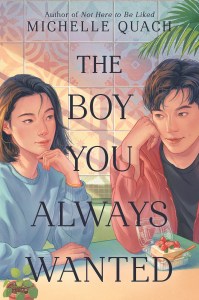
ARC Review: The Boy You Always Wanted by Michelle Quach

Francine always has a plan. Ollie wants no part of it.

Francine loves her grandfather, but their time together is running out. He has one final wish: to see a male heir carry on the family traditions. Francine knows his ideas are outdated, but she would do anything for him. Her solution? Ask Ollie Tran, a family friend (and former crush, not that it matters), to pretend to be ceremonially adopted and act like the grandson A Gūng never had.

Ollie generally avoids the odd, too blunt (and fine, sort of cute) Francine, whose intensity makes him uncomfortable. So when she asks him to help deceive her dying grandpa, Ollie’s not down. He doesn’t get why anyone would go to such lengths, even for family. Especially with a backwards (and sexist, Ollie keeps stressing) scheme like this.

Francine, however, is determined to make it happen, and soon Ollie finds himself more invested in her plan—and in her—than he ever thought possible. But as the tangled lies and feelings pile up, Francine must discover what exactly she needs for herself—and from Ollie. Because sometimes the boy you always wanted isn’t what you expected.


Overall Recommendation:

With deep insight into family responsibilities in an Asian household, The Boy You Always Wanted poses the question of love for our family members while struggling with cultural viewpoints that are outdated in today’s society. I find this read was particularly impacting because I 100% relate to the premise, however, for those who aren’t Asian or their families are not like this, the story can still be fun with the cultural elements an insight into the workings of the Asian diaspora.

**The Boy You Always Wanted comes out August 1, 2023**

Thank you Edelweiss and the publisher for this copy in exchange for an honest review

When it comes to Asian representation in YA, you know I’m there. The premise of The Boy You Always Wanted hit close to home for myself and the author, and perhaps many of us who know what it feels like to be a girl in a culture where it’s seen as secondary.

Francine’s grandpa is dying but to deal with the grief of impending loss, she wants to make him feel at peace with what he’s leaving behind. I really loved this aspect of the story. I felt seen in this book, navigating Asian experiences in a modern world. While I understand people may come into this book with expectations of sexism resolved and people standing up for themselves, it’s not always quite so simple.

For the author and myself and any of you who knows what it feels like to be seen as less than in this way, the resolution isn’t something that may be present in the lifetime of those we love. I appreciated how Michelle asked that question throughout: how do we reconcile our deep love for our family members with the sexist and outdated views they carry in this modern society? I see it in myself sometimes as the granddaughter next to my younger brother. I see it in my mother’s family, to have 5 kids just so grandpa can ensure there is a son born into the line. I see it in my father’s family, where I’m treated slightly better as my father’s daughter than my cousin as my aunt’s daughter. How do I balance the love I have for my grandparents and the love I know they have for me even though certain comments don’t sit well? There’s no easy answer, and for that I appreciate it wasn’t just brushed aside so easily with a fix-all solution. Sometimes, there really is none. We can only hope to do better by teaching the next generation better.

That being said, while I loved the cultural aspects and deeper thought behind the story, everything else was not as great. I couldn’t get behind Ollie’s extremely dislikable character. He was awful to Francine, up front and in his thoughts since we get his POV. His redemption wasn’t enough, especially with how rushed the romance felt on his part. He wasn’t a terrible person as he did do his best to play the male heir part for Francine’s grandpa, but he just wasn’t very mature. I liked Francine well enough, even all the “quirks” that bugged Ollie and the others. I just don’t feel their romance worked as he didn’t respect her enough for so long. It was like the excuse boys pick on girls because they like them, not because they’re simply bullies.

The pacing was also a little slow with not much build. The climax wasn’t as crazy as I anticipated but at the same time was oddly predictable once the “twist” from left field was made known to us. I will reiterate that this story isn’t just for Chinese Americans or Chinese Vietnamese (which holds a dear spot in my heart). There’s lots that can be learned from such an intimate look at filial duties and family dynamic here, however, what propels you to finish it may be stronger if there is more of a personal connection like there is with me.

3 star, YA

ARC Review: Clementine and Danny Save the World (and Each Other) by Livia Blackburne

You’ve Got Mail gets a YA twist in this rom-com that spotlights the power of activism and community organizing in the face of gentrification.

Clementine Chan believes in the power of the written word. Under the pseudonym Hibiscus, she runs a popular blog reviewing tea shops and discussing larger issues within her Chinatown community. She has a loyal, kind following, save for this one sour grape named BobaBoy888.

Danny Mok is allergic to change, and the gentrification seeping into Chinatown breaks his heart. He channels his frustration into his internet alter ego, BobaBoy888, bickering with local blogger Hibiscus over all things Chinatown and tea.

When a major corporation reveals plans that threaten to shut down the Mok’s beloved tea shop, Clementine and Danny find themselves working together in real life to save this community they both love. But as they fall hard for this cause—and each other—they have no clue that their online personas have been fighting for years.

When the truth comes to light, can Danny and Clementine still find their happily-ever-after?


Overall Recommendation:

Clementine and Danny Save the World (and Each Other) is an introspective take on Chinese culture and its impact on the diaspora community that settles in a North American city, especially the gentrification of old neighborhoods. The seriousness of the subject matter is routinely balanced out with the levity of tea blogging and many fun facts on the appropriate brewing of tea. I feel more connected to such a story as a Chinese reader, however I do think this story is informational in a way that’ll connect others too.

**Clementine and Danny Saves the World (and Each Other) comes out July 18, 2023**

Thank you Edelweiss and the publisher for this copy in exchange for an honest review

Where shall I begin?

First of all, as a Chinese Canadian reader, I feel pretty close to the subject matter at hand. In this story, Clementine and Danny fight against the impending take over by some big corporate group of a strip mall in Chinatown where they grew up in their town. While it may seem the revamping of an old mall would be ideal for the neighborhood on paper, it really can have negative consequences for the regular patrons and shop owners who actually live in the area.

I will admit I have some mixed and conflicting feelings that I do feel the book fleshes out. Danny, as the son of the owners of Fragrant Leaves, the tea shop in said strip mall, has good insight into the loss of such of corporate takeover. Besides losing out their business and livelihood, what makes up the beating heart of Chinatown will be lost. What exactly is that, you ask?

Chinatown isn’t just made up of the independent stores there. It’s in the elderly who regularly hang out in such places to socialize, play mahjong, and drink some tea. It’s in the hardships the immigrating generation conquered or persevered through the losses to come out on the other side. It’s the memories steeped into a place, the tears and sweat poured out within the confines of old decor and non-modernized technology.

Yes, there is loss here, always, when old is replaced with new. However, there is a flip side, and Clementine brings that into perspective. As a daughter of successful journalists who are considered more upper class, she brings ideas of modernization, Asian fusion and social media connections to promote Asian culture, even in the form of the kinds of tea to drink. She sometimes is idealistic and/or ignorant with her ideas that she posts to her tea blog – reviewing tea sounds like a fun topic actually – but I can also see where she’s coming from. Sometimes, change is necessary to adapt. Culture and tradition have its place, but it’s not traitorous to suggest a middle ground for the next generation in the diaspora to learn and love components of Chinese culture. We are the diaspora, after all. Two identities waging war, fitting in both cultures…or fitting in none.

I didn’t love that Danny made it seem Clementine was always in the wrong for her suggestions. She loved Chinatown, and this was her genuine way to try to bring in more people. Not all ideas work, but her heart was always in the right place. I’m not sure if the author also believes Danny’s POV and pragmatism is always right, but my personal take away is it’s always complicated. Some things I love to keep it the traditional way (drinking pu’erh tea with milk or sugar is a big fat NO), but I also love Asian fusion dishes that certain dim sum places offer.

That brings me to the romance. I honestly didn’t feel it. Danny was so awful to Clementine in her blog’s comment section, even though he didn’t know her to be the anonymous tea blogger. And when some of the things she believed about her Chinese culture differed from what he did, he blew up at her. His apology wasn’t enough, especially when he came across as superior because his parents worked physically hard to keep their store afloat. Are you saying Asians who study hard to afford more white collar jobs and therefore have more money only want to gentrify neighborhoods? He got on my nerves with his self righteousness. So no, I didn’t understand the reality of a romance forming here unless Clem changed all her beliefs to fit his.

The activism part of the story was purely informational, and frankly took up way too much page space. We don’t get to see these two characters anywhere outside of volunteering for the Chinatown nonprofit to save the neighborhood. Besides that they care about their neighborhood, there was little else about them we get to see. Additionally, how all their work played out didn’t really satisfy at the climax which made me wonder why so much time was given to this plot element.

All in all, I like the discussion around Chinese culture, tradition versus modernized “influencer” views, and the impact Chinatown has on those around it. I definitely felt seen with my array of emotions stemming from personal experiences in such places growing up. I didn’t love the ending or the romance but I firmly believe it is still a good read for Asian and non-Asian readers alike to learn from and discuss.