2 star, YA

ARC Review: A Disaster in Three Acts by Kelsey Rodkey

Fans of Elise Bryant and Rachel Lynn Solomon will swoon for Last Chance Books author Kelsey Rodkey’s next romance, packed with snark, banter, and inconvenient crushes.

Saine Sinclair knows a little something about what makes a story worth telling.

Your childhood best friend refuses to kiss you during a pre-adolescent game of spin the bottle? Terrible, zero stars, would not replay that scene again. The same ex-friend becomes your new best friend’s ex? Strangely compelling, unexpected twist, worth a hate-watch. That same guy–why is he always around?–turns out to be your last shot at getting into the documentary filmmaking program of your dreams?

Saine hates to admit it, but she’d watch that movie.

There’s something about Holden that makes her feel like she’s the one in front of the camera–like he can see every uncomfortable truth she’s buried below the surface. Saine knows how her story’s supposed to go. So why does every moment with Holden seem intent on changing the ending?


**A Disaster in Three Acts comes out July 5, 2022**

Thank you Edelweiss and the publisher for this copy in exchange for an honest review.

Aptly named, the storyline followed its title as it really was a disaster in three acts at times. I wonder if Kelsey Rodkey is an author that works for me because this is her second book and the second time I struggled to love it. I’ll try to list out the reasons why A Disaster in Three Acts didn’t work for me personally.

The protagonist is always key when it comes to a book. Maybe it isn’t as much for others, but I strongly believe even a great story can be awful if you really don’t like the narrator/protagonist you’re stuck with. Saine, pronounced “sane” as in the second syllable of “in-sane” – which the book clarifies and not just what I’m telling you, is a mess. Honestly. I love character arcs where they face growth through the mistakes they make but she’s just not someone to be sympathetic for.

She’s so selfish. I hated seeing how she put her documentary “story” and how she wanted to craft the excitement for her tale by twisting or manipulating events that may not be quite be the truth. She was right in the sense that this strays from documentary to realistic TV realm. And we all know how “truthful” reality TV is, don’t we?

Her documentary subject is Holden, her childhood best friend and former crush. I love that romance trope. Trust me, I really wanted to enjoy it. But when she practically self sabotages growing feelings and places her documentary film over the very real guy she’s filming, I’m no longer Team Saine. Holden deserves better and it sucked to see how much she went behind his back and even her new best friend who formerly dated Holden.

The pacing wasn’t great either. The main premise for the book and the documentary she’s filming was about a competition Holden had entered to win a grand prize. I thought the competition would definitely last longer and be a larger focal point but that was sadly not the case. It ended maybe not even halfway through the book so we’re left with the ability to go off script in Saine’s creative process. Hence the lovely plot ensuing surrounding her less than honorable filming tactics.

If I didn’t enjoy Saine as a character or the potential romance with Holden, there’s really not much more room to love anything else. Her group of friends are somewhat featured as Corinne, her new best friend, definitely adds to this weird love trope. Is it a girl’s code to never date your best friend’s ex? Does it count if you were technically friends with them first and had a HUGE crush once upon a time? Either way, that was a little entertaining but hardly sustainable for a full length book. They had their friendship problems and I’m glad the book took time to discuss it without only pitting one girl against the other.

The only thing that was really interesting and unique about the story was the mini plot dive into grief and how it’s handled (or not handled). Saine’s grandmother passed away prior to the start of the book but her impact on Saine’s creativity, love of documentaries and art are very much present. I liked that it was subtly explored as I’m sure people grieve differently and communicating such grief, especially between the remaining family members, is so important.

But, I’m sure that’s not what everyone came to this book for, so please take what you will from this review. It may just be me, but honestly, I’m not sure Saine’s a very likable protagonist in general. Flawed, yes. The intriguing morally gray? No. So perhaps you’ll like it, but perhaps you also may not.

Overall Recommendation:

A Disaster in Three Acts at least lived up to its name because Saine as a protagonist was truly disastrous. The plot wasn’t compelling with the documentary she was filming and her whole relationship with Holden was more selfish than romantic. There’s not a whole lot left to love but perhaps a more sympathetic reader will find more joy in its pages. At least for me, this was a no.

4 star, YA

ARC Review: Our Crooked Hearts by Melissa Albert

THE SUBURBS, RIGHT NOW . . .

Seventeen-year-old Ivy’s summer break kicks off with an accident, a punishment, and a mystery: a stranger whose appearance in the middle of the road, in the middle of the night, heralds a string of increasingly unsettling events. As the days pass, Ivy grapples with eerie offerings, corroded memories, and a secret she’s always known—that there’s more to her mother than meets the eye.

THE CITY, BACK THEN . . .

Dana has always been perceptive. And the summer she turns sixteen, with the help of her best friend and an ambitious older girl, her gifts bloom into a heady fling with the supernatural, set in a city of magical possibilities and secret mystics. As the trio’s aspirations darken, they find themselves speeding toward a violent breaking point.

Years after it began, Ivy and Dana’s shared story will come down to a reckoning among a daughter, a mother, and the dark forces they never should’ve messed with.


**Our Crooked Hearts comes out June 28, 2022**

Thank you Flatiron Books for this ARC in exchange for an honest review.

Chilling, gripping and full of familial drama, Our Crooked Hearts blew through all my expectations and I couldn’t put it down.

At the heart of this story is the bond between Ivy and her mother. Which isn’t a very good one as Ivy knows Dana is keeping something big from her (and the rest of the family). Although the synopsis suggests it’s evenly split between Ivy and the flashbacks to Dana’s childhood, it doesn’t really start off that way.

We get a lot of chapters about Ivy’s current life in the suburbs. All is well…that is, until she encounters a strange woman in the middle of the road late at night who may have more than a passing curiosity about Ivy. The story dives into this really quick, which I thoroughly appreciate, and sets the tone for the following strange events to come.

Once Dana’s flashbacks start coming, it provides great context to us, the omniscient reader, about what she’s hiding from the family – and perhaps how this stranger in the present day is related to what once happened. I’m normally not the biggest fan of two alternative POVs in different timelines as one is normally stronger than the other and I would much prefer to stick with the one I like. However, I found myself not begrudgingly reading Dana’s POV but also coming to like those chapters too. They filled in gaps we’re still piecing together, but the anticipation for figuring out how everything related was oddly satisfying.

I had the privilege of hearing Melissa speak about the writing process for this book and I fully understand how the story needed to be told from both Ivy and Dana’s POVs. It might’ve started off as Ivy’s story, but humanizing Dana instead of making her the enemy in Ivy’s eyes shows the complexity of humans, not just the black and white we sometimes get depending on whose perspective you’re told.

This book is also full of magic. It’s not very specific to any witchcraft practiced in modern society but a little bit of everything. Melissa did her research and it showed. The end result was an eerie tale that highlighted the price one pays when they meddle with forces they do not understand.

The pacing was excellent and the time really flies by as you switch from Ivy to Dana and back again. The underlying mystery, the strange events occurring present day and the secrets unfolding were the perfect balance to drive momentum to the climax. The one thing I will add is that I had hoped for more resolution in Ivy and Dana’s relationship. While we get a lot of information about them separately in their individual POVs, there’s not a lot of interaction between them and I feel that could’ve been explored a little more.

If you’ve read any book by Melissa Albert before, you already should know she’s a masterful storyteller, but if you’re new, then you’re in for a treat. Our Crooked Hearts presents a perfect story in the dark with plenty of magic, mayhem and mystery. You should definitely grab this one when it comes out!

Overall Recommendation:

Our Crooked Hearts is a fast-paced tale with a supernatural mystery that may tie to a family’s past. Excellently told in two alternative timelines featuring mother and daughter, I found myself loving both POVs as they blend the perfect story together, each adding pivotal information as we race to solve the present day’s strange occurrences before something terrible happens. Melissa Albert’s latest novel is another showcase of her amazing storytelling. Trust me, it will grip you in its hold until the end.

1.5 star, adult

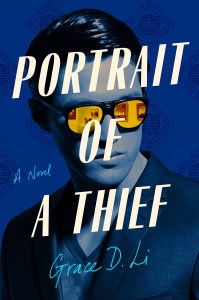
Review: Portrait of a Thief by Grace D. Li

History is told by the conquerors. Across the Western world, museums display the spoils of war, of conquest, of colonialism: priceless pieces of art looted from other countries, kept even now. 

Will Chen plans to steal them back.

A senior at Harvard, Will fits comfortably in his carefully curated roles: a perfect student, an art history major and sometimes artist, the eldest son who has always been his parents’ American Dream. But when a mysterious Chinese benefactor reaches out with an impossible—and illegal—job offer, Will finds himself something else as well: the leader of a heist to steal back five priceless Chinese sculptures, looted from Beijing centuries ago. 

His crew is every heist archetype one can imag­ine—or at least, the closest he can get. A con artist: Irene Chen, a public policy major at Duke who can talk her way out of anything. A thief: Daniel Liang, a premed student with steady hands just as capable of lockpicking as suturing. A getaway driver: Lily Wu, an engineering major who races cars in her free time. A hacker: Alex Huang, an MIT dropout turned Silicon Valley software engineer. Each member of his crew has their own complicated relationship with China and the identity they’ve cultivated as Chinese Americans, but when Will asks, none of them can turn him down. 

Because if they succeed? They earn fifty million dollars—and a chance to make history. But if they fail, it will mean not just the loss of everything they’ve dreamed for themselves but yet another thwarted at­tempt to take back what colonialism has stolen.

Equal parts beautiful, thoughtful, and thrilling, Portrait of a Thiefis a cultural heist and an examination of Chinese American identity, as well as a necessary cri­tique of the lingering effects of colonialism.

Ocean’s Eleven meets The Farewell in Portrait of a Thief, a lush, lyrical heist novel inspired by the true story of Chinese art vanishing from Western museums; about diaspora, the colonization of art, and the complexity of the Chinese American identity.


This is probably the saddest review I have to write because I had such high expectations for Portrait of a Thief. While I know this book may not have been written with every audience in mind, I feel I am one of those this was meant to excite. I feel I am one of those whose thoughts should hopefully matter as I navigate the complex feelings this book has sprung out of me.

I am Chinese Canadian and this book about the diaspora of Chinese immigrants across the Western world is, well, me.

Like most of the characters we follow in this heist crew, I was born in a Western society with only parental roots tying me back to my mother country. Yet my own complex relationship with China is not quite what any of these students feel. While many have praised the different voices or feelings each character wrestled with for their reasons to take on a heist job for China, I personally feel they were mostly one-note and the same. All their internal conflict, and oh boy was the book full of the same conflict for each character, was about escaping their prison-like futures weighed down with expectations and familial responsibilities, and not quite belonging to either country.

I can see that. I witness it sometimes in myself when I’m overseas and a person in China can immediately guess I am not from there simply from the way I dress and behave even if I speak Chinese to them. I also know that no matter I was born in Canada, people will see me and I will always be ‘other’ in some way, no matter that my English is perfect. But I don’t think it’s so simplified in the same way for every child of immigrants in this diaspora to feel so lost that it leads to the risk of a lifetime. I mean, the book wouldn’t exist if they hadn’t all felt drawn to such a risk worth taking, but it was hard to swallow after the 50th chapter mentioning the internal conflict in some form as they continued to take risk after risk to the point beyond recklessness for a country that also wasn’t quite fully theirs either.

Out of the 5 protagonists, I resonated most closely with Alex. Note aside, she has the same name as one of my good friends so that was a fun thing to see in a book. But it makes me question a little why I connected with her the most. Is it because she’s the only one who is Cantonese with a background from Hong Kong?

This is another thing the book doesn’t do well in. My family is from Hong Kong and it has a very different, even more complex, relationship with China. It’s probably another reason why I was so torn with the internal conflict of these students because it’s never addressed although Alex is so very much here. Even with her last name written in this way, Huang instead of Wong, she could’ve just been another Mandarin-speaking student and I wouldn’t have known the difference if her Cantonese family wasn’t mentioned. Why is that? It makes me wonder why nothing more was ever specified. Why include it then at all? It adds to the similarity of all these students which don’t represent the vast diaspora of Chinese immigrants. And I speak this from experience.

The story could’ve been saved with the levity that complex heists and creative escape plans might have brought with it. Yet this book is very much focused only on the identity struggle of the protagonists and not so much on the actual risks they are taking. It made the story drag as the heists were more an afterthought than any focus at all. I wouldn’t have minded it, in fact, I was warned that was the case. But I needed the levity for my own heart’s struggle and it just wasn’t there. I could barely swallow several chapters at a time because it was so heavy, and each student’s grief over their future and their identity was so dominant. The chapters aren’t even long yet I felt every one last half a lifetime.

The interpersonal relationships between all of them were also lacking. There were no feelings that jumped out of the page beyond what the words were telling me to feel. Will felt something that perhaps was more than his usual affair with Lily, but I never understood why that was. What made their interaction more special? Was it because they were planning a heist together with the added adrenaline thrown into the mix? The sapphic relationship also felt thrown out of left field because I never understood how it grew to love when all we’ve ever been given was the hate. It wasn’t even enemies-to-lovers done well.

And now we circle back to how I feel at the end of all of this. Portrait of a Thief was one of my most anticipated books, one I predicted I would love so much. It physically hurts that it’s not the case because I thought this book was written for someone like me. On a subject that was important and meant to be seen. Maybe it’s all too personal to me which is why it didn’t work out. Maybe I have too many connections to the history, to the countries, to the struggle for it to have ever worked out.

I’m left with questions I can only reflect to myself as I read each characters’ own questions. Would I have risked it all for a country that doesn’t fully accept me either? Would doing something as big as taking back power in the form of art be enough to make me belong? I’m not sure the answer is ever easy or so simple to make. It doesn’t even have to relate to heists and art, but simply this question: what lengths would I go to to feel like I belong in the freedom of all that I am?

And the fact that these college students wrestled so much with their futures to want to run from it, and very great futures at that with the privilege of attending the greatest universities in America that only some of us can ever hope to achieve, made me wonder if there’s something off with me for never having such a thought cross my mind with the expectations placed on the eldest child of an immigrant family who left it all behind for a greater chance in a different country.

Yes, this review is very introspective, and it’s not the usual take I have for books. But this book was written for me in many ways that most books are not. And perhaps the pain of not liking it at all is only amplified for that very reason.

Overall Recommendation:

Honestly, I can’t write a good TL;DR for Portrait of a Thief. If you want to know my thoughts, please read the entirety of it because it’s way too complex to put into a pithy summary. This is my history, this is my identity, and this book wrecked in me in a way I didn’t expect it to.