4 star, YA

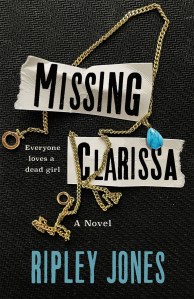
ARC Review: Missing Clarissa by Ripley Jones

In a gripping novel perfect for fans of Sadie and A Good Girl’s Guide to Murder, two best friends start a true crime podcast—only to realize they may have helped a killer in the process.

In August of 1999, dazzlingly popular cheerleader Clarissa Campbell disappears from a party in the woods outside the rural town of Oreville, Washington and is never seen again. The police question her friends, teachers, and the adults who knew her—who all have something to hide. And thanks to Clarissa’s beauty, the mystery captures the attention of the nation. But with no leads and no body, the case soon grows cold. Despite the efforts of internet sleuths and true-crime aficionados, Clarissa is never found—dead or alive.

Over twenty years later, Oreville high-school juniors and best friends Blair and Cameron start a true crime podcast, determined to unravel the story of what—or who—happened to this rural urban legend. In the process they uncover a nest of dirty small-town secrets, the sordid truth of Clarissa’s relationship with her charismatic boyfriend, and a high school art teacher turned small-town figurehead who had a very good reason for wanting Clarissa dead. Such a good reason, in fact, that they might have to make him the highlight of their next episode…

But does an ugly history with a missing girl make him guilty of murder? Or are two teenage girls about to destroy the life of an innocent man—and help the true killer walk free?


Overall Recommendation:

Missing Clarissa combines a few elements that make this story compelling: intriguing protagonists, a commentary on missing white girls, and a podcast style of storytelling. While I’m always down for a good mystery, the best things about this book isn’t really the whodunnit. Whether it was predictable or not earth shattering enough, this book gives on social commentary as well as a realistic growth arc for the two protagonists. I came in looking for a simple mystery but got a lot more out of it.

**Missing Clarissa comes out March 7, 2023**

Thank you Netgalley and the publisher for this copy in exchange for an honest review.

Blair and Cam are two ordinary teenagers who find themselves looking back on the legendary cold case in their town. A local girl disappeared many years ago without a trace, sparking nationwide attention and many theories to her whereabouts as her body was never found. Is she even dead or alive?

There are a number of things I really enjoyed about this book, and oddly enough, the mystery itself isn’t the chief reason. Firstly, I really enjoyed both Blair and Cam as our protagonists. Blair was the one who gave into other people’s desires, whether it was Cam’s more exuberant personality or her boyfriend’s domineering attitude. Cam, in contrast, knew who she was and didn’t care what others thought. What was more enjoyable was their interaction with one another. On paper, they don’t look like they could be best friends, and yet, their opposing natures balanced one another and forged the other to see from a different perspective.

I also really liked how they came across as real teenagers. They made mistakes, super dumb ones. And the whole reason they started this thing into Clarissa? For a school assignment. With the slight narcissistic thought that they’d be able to crack what others couldn’t over the years. I mean, what college would say no to you if you solved a cold case with this level of media scrutiny?

In the vein of recent mystery favourites featuring podcasts like Sadie and A Good Girl’s Guide to Murder, each chapter was divvied up by the subject matter they were interviewing with regards to the case. I’m not sure what it is about mysteries with podcasts formats, but there’s something about it that keeps us on our toes as we watch, like a podcast audience, what would happen next. I did like this format in this novel, but it did feel more of a plot device than something integral to the storytelling.

And lastly, there is the commentary between the girls and their journalism class. Clarissa, as a beautiful white girl, gets all this media attention for being missing, yet thousands of other girls disappear all the time, namely from Indigenous backgrounds. I appreciated this running thought here because it is something to be mindful of in our own society. It’s not heavily discussed, but its presence here is a question. Would Clarissa have gotten such fervor from her community and around the country if she wasn’t a white, blond girl?

Now, I’ve written a number of things that aren’t the mystery, but I’ve yet to comment on how I felt about it. I love mysteries, and I’ve read my fair share. While this novel isn’t something that will shake your core with its ending, I will say I didn’t guess everything immediately. It may not be earth shattering in its plot twists but I don’t think the purpose of this mystery is simply just a whodunnit. Missing Clarissa brings more to the table, and for that I’m quite pleased with how everything turned out.

discussion

Let’s Talk Bookish – Book Stopping Places

Aria @ Book Nook Bits is the new host for Let’s Talk Bookish! If you aren’t following her yet, good check out her blog and give her a follow!

 March 3: Book Stopping Places? (suggested by me!)

Prompts: Are you the type of reader able to stop reading just anywhere? In the middle of a sentence? Paragraph? Or do you need to reach the end of a chapter before stopping? What do you do if you can’t stop at a good point – do you have to go back right away to stop at a better place? Do you use bookmarks in a special way to remember where exactly you are? How uncomfortable does it make you to stop in the middle of an exciting part of the book, and how do you deal with that?

Welcome to another week here at LTB! Today’s topic was suggested by none other than yours truly. I thought about it one day and wondered, what does everyone else do regarding this? So I just had to submit it. Thanks to Aria for taking it up and posting it though!

I am usually not the type of reader to stop anywhere. Ideally I like to stop at the end of a chapter. Or at the very least at the end of a paragraph. Or if I’m desperate to leave at the end of a sentence. See the pattern here? I think one of the big problems about stopping randomly is that things usually take place in a chapter because it follows the same train of thought, idea, or general storyline; if you stop for too long and forget to come back, you basically have to re-read the whole chapter again lest you forget where you were. Unless you pick it back up quickly enough, of course.

I usually attempt to just keep going when I come back to the book. Usually, if it was just a quick break for something like an interrupting parent or pet, it really isn’t a big deal. I do recall having to read the same page a couple of times sometimes though, just to try and figure out what exact frame of mind I was in, and what exactly was happening to the story. Sometimes you just can’t choose when you are interrupted though, no matter how hard you try. And that’s just how it is.

I usually read books on my library app on my phone, so I don’t need to use bookmarks for that. But for physical books, I often will put the bookmark sideways to indicate which line I am on. Sounds smart right? Except that usually when I come back to it, I don’t remember which side I was referring to anyway (left page or right page), and even if I did, I don’t truly just start from the same line. Admitting this, I’m not even sure why I bookmark it that way—I usually just end up scanning or skimming the whole page anyway to find where I was.

Let’s just say…I don’t like being interrupted while reading. I like choosing where to stop, and deliberately putting it down. Not expecting to have to stop and being interrupted really interrupts the flow of a reading session. That being said, obviously sometimes it just can’t be helped. But the only real solution is, like many of you have said, is just to put it down and get right back to it as soon as possible. And that’s definitely the solution I go by too. No one likes leaving the book at the best part! I am already super guilty of needing to finish books despite my other obligations, and this is of course especially the case when I find the story riveting.


And that’s a wrap! Thanks for participating in my prompt everyone! Point me to your own answers in the comments and let’s see how you all take breaks in your reading! Do any of you have any special habits for stopping places?

discussion

Let’s Talk Bookish – Are Reading Goals Worth It?

Aria @ Book Nook Bits is the new host for Let’s Talk Bookish! If you aren’t following her yet, good check out her blog and give her a follow!

February 24: Are reading goals worth it? (Aria)

Prompts: We’re two months into 2023 – how are you feeling about your reading this year? Do you have a yearly reading goal? Do you think that those kinds of goals help you to feel motivated to read more books, or just causes stress? If you set yearly reading goals, when and why did you start setting them? Would you consider reading without aiming for a number? If you don’t set reading goals, why not?


Welcome back to another week of LTB here at DTRH, everyone! It’s already the end of February somehow, and the prompt today relates directly to that. Although it’s interesting, I’ve never really considered whether goals are worth it or not. Can’t wait to hear what you all have to say on this as well!

My reading this year so far has been decent I think. While not reading consistently, I have been able to slip in some reads here and there, which I think is all I can ask for at this busy juncture. I honestly can’t believe it’s been two months already, but it’s always nice to get some reading done during downtime or waiting periods. I definitely do have a reading goal this year, but I have set it pretty low, as to have more realistic expectations of how much time I actually have.

These goals don’t necessarily help me feel more motivated to read books, but certainly do not cause me stress. If I don’t have time, I just don’t have time. They are a good reminder of the fact that I always feel great finishing another book though, so in that way it does help me feel a little more motivated to put in some reading time where I can. If goals only stress you out, I’d definitely suggest modifying those goals or setting smaller piecemeal ones that won’t stress you out as much. Although perhaps some of you read well under stress…?

I’ve set yearly reading goals (more publicly) for more than a few years now, when I got more involved on the blog. I think it’s something nice to keep track of, and I feel like no matter what number I reach, I’d be pretty proud of it, and at least happy to keep track of what books I have read so that I can suggest content to others. I definitely read no matter whether I have a goal or not, and I suspect many of us in the community would too. However, it’s still good to have a goal or at least a tracker to see how far you’ve come along on your reading journey. Sometimes the reminder of your goal serves more to remind you to read once in a while, rather than about actually finishing the goal or reaching a checkpoint.

For those of you who specifically choose not to put reading goals, do you still keep track of the books you have read somewhere? If you do have reading goals, are they worth it to you? Let me know in the comments below!