3.5 star, YA

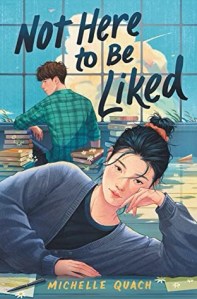
Review: Not Here to Be Liked by Michelle Quach

Emergency Contact meets Moxie in this cheeky and searing novel that unpacks just how complicated new love can get…when you fall for your enemy.

Eliza Quan is the perfect candidate for editor in chief of her school paper. That is, until ex-jock Len DiMartile decides on a whim to run against her. Suddenly her vast qualifications mean squat because inexperienced Len—who is tall, handsome, and male—just seems more like a leader.

When Eliza’s frustration spills out in a viral essay, she finds herself inspiring a feminist movement she never meant to start, caught between those who believe she’s a gender equality champion and others who think she’s simply crying misogyny.

Amid this growing tension, the school asks Eliza and Len to work side by side to demonstrate civility. But as they get to know one another, Eliza feels increasingly trapped by a horrifying realization—she just might be falling for the face of the patriarchy himself.


Not Here to Be Liked has left behind an impression on me that is both hard to eloquently write down and make coherent sense. I will try to organize it in some way, but please bear with me.

Firstly, I knew I was in love when I first turned on the audiobook and heard the first few chapters. Eliza Quan is a Vietnamese Chinese girl with parents who immigrated to North America as refugees from the aftermath of the Vietnam War. Her family has kept Chinese roots regardless of living in Vietnam for at least a generation so their household speaks a combination of Vietnamese and Cantonese. I’m just going to say that seeing (or rather, hearing) the Cantonese and every day references mentioned sent a delighted thrill of surprise through me. Like the following quote:

“Make sure you have enough rice to eat.”

Quan family motto

You have no idea how many times I grew up hearing this from my grandparents. It’s why I’m more of a noodle person as an adult because I had way too much rice as a child.

This made me feel like Eliza (and her family) was someone I intimately knew right away. Like she could’ve been a part of my family. Or my boyfriend’s family. It was so surreal to feel represented in fiction because I’m quite used to never seeing that. Even amidst the surge of Asian representation in YA, there was never any protagonist that quite hit the nail like Eliza did for me. (I won’t nitpick that the Cantonese spoken on the audiobook wasn’t quite without an accent, but it was still amazing!).

But aside from my personal connection to Eliza and her family, this book is about feminism. Or rather, the unwitting face of feminism Eliza becomes when someone released her rant – aka manifesto – about losing the school paper’s editor in chief vote. To a boy.

Maybe like most of us, we wouldn’t know what to do when we become the face of feminism among our peers. I sure wouldn’t. So all of a sudden, she’s launched into infamy, targeted by certain classmates with awful comments on social media and scrawled across her locker. Which in and of itself is sexist as the manifesto equally targets Len as the “face of patriarchy”. Why wouldn’t he get equal treatment against him, the target of the paper?

This exploration of “what makes one a feminist” and “how should a feminist act” was one I had to sit with for a while in writing this review. What does one immediately think of when we say “feminism”?

I’m a feminist, not a narcissist.

Eliza Quan

I do applaud Michelle Quach’s thoughts in the form of Eliza’s own internal questions and the different women she wrote about. Eliza definitely sat more in the middle, wanting to do her part, but not knowing if interacting with the enemy Len, made her a hypocrite and a terrible feminist. Her best friend Winona leaned more into the stereotype, for better or worse, that feminism sometimes bring to mind, wherein it’s more synonymous with anti-male. Meanwhile, the popular girl Serena that came into their lives in the aftermath of the manifesto embodied more of social action for something she stood for while not particularly looking or acting a certain way towards men. There was definitely growth in all three girls as they spearheaded the growing feminist movement in their school, but it was interesting noting the different directions each came at this same movement.

Quach also explored a little the impact of Asian cultures in wiring how women think through the experiences and stories Eliza’s mom told her, and the way she wanted her own daughter to behave. I appreciated that too because I can acknowledge it’s definitely there and prevalent in our societies even now. We do need more stories like this among POC communities, although I will also acknowledge it is a clash of Western and Eastern ways of thinking.

The romance, it seemed, fell somewhere behind all of this. It’s probably the only reason why I lowered my rating. I didn’t particularly feel the chemistry between Len and Eliza in their interactions. It could be because she wanted to hold onto her animosity towards him the whole time, but in getting to know Len, I came to realize he’s a pretty good guy and didn’t deserve the “face of the patriarchy” label. Of course, he still got off easy in the eyes of his peers (sexism, am I right?), but he wasn’t the villain the manifesto painted him out to be – or what I thought he’d be coming into this book.

Did I think it was a fun romance still? Sure, it was fine, but if a solid “enemies to lovers” trope is what’s bringing you here, you may need to rethink it a little. It’s definitely not the focus of this story.

All this to say, I reflected a lot as a result of reading this book about feminism and how I see myself, even, as a young woman in my society and among my peers. It’s made me think about how I can fight for equality, not superiority in any one sex, in my own life. And I think that is the point of this book, so it has done the job it’s set out to do.

Because feminism, contrary to popular belief, isn’t about hating on guys…It’s about all of us working toward equality, together.

Overall Recommendation:

Not Here to Be Liked was a wonderful reflection on feminism, especially in a young Asian girl where the culture largely dictated patriarchal values. I really enjoyed seeing the Asian influences and representation in this story, namely because Eliza spoke my language and has a very similar background with my own family. That being said, the book explores what it means to be a feminist in a way that is not condescending and looks at different angles through its various characters. While a romance is also present between Eliza and the “face of the patriarchy” Len, it is by far not the focus so the enemies to lovers storyline wasn’t fully fleshed out to satisfaction for romance lovers. Regardless of that one minor thing, I do think this is a worthwhile novel to pick up for its niche exploration of feminism in an Asian protagonist that sets it apart from other books currently out there. My thoughts may be a little all over the place, but this I know to be true at least.

3.5 star, YA

Review: The Bronzed Beasts by Roshani Chokshi

The Gilded Wolves #3

In love they breathed. In destiny they believed. In the end, will divinity be their demise?

After Séverin’s seeming betrayal, the crew is fractured. Armed with only a handful of hints, Enrique, Laila, Hypnos and Zofia must find their way through the snarled, haunted waterways of Venice, Italy to locate Séverin.

Meanwhile, Séverin must balance the deranged whims of the Patriarch of the Fallen House and discover the location of a temple beneath a plague island where the Divine Lyre can be played and all that he desires will come to pass.

With only ten days until Laila expires, the crew will face plague pits and deadly masquerades, unearthly songs and the shining steps of a temple whose powers might offer divinity itself… but at a price they may not be willing to pay.

Returning to the dark and glamorous 19th century world of her New York Times instant bestseller, The Gilded Wolves, Roshani Chokshi dazzles us with the final riveting tale as full of mystery and danger as ever.


Another trilogy ends! This time, it’s The Gilded Wolves series. Although long anticipated, this ending was a bit of an unexpected one. Andge and I both agree that it was neither terrible nor bad, yet perhaps was something neither of us was expecting. Overall, I’d say that I enjoyed the many themes that were present and the way that the book played out and wrapped up the series was satisfying enough. Whether it was the ending I wanted, or whether I know what I would have preferred to see, I can’t say with certainty.

The Bronzed Beasts is the final book in The Gilded Wolves trilogy. For one last time, the story revolves around Séverin and his fractured team, taking place after his big display of betrayal in the Sleeping Palace. The journey is once again presented in multiple POVs, and as everything build up to a climactic finish with divinity hanging as a trophy, it is difficult to see what will happen and who will be left behind.

Continue reading “Review: The Bronzed Beasts by Roshani Chokshi”
3.5 star, YA

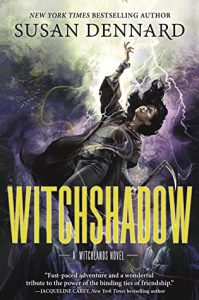
Review: Witchshadow by Susan Dennard

Series: The Witchlands #4

Susan Dennard’s New York Times bestselling, young adult epic fantasy Witchlands series continues with Witchshadow, the story of the Threadwitch Iseult.

War has come to the Witchlands . . . and nothing will be the same again.

Iseult has found her heartsister Safi at last, but their reunion is brief. For Iseult to stay alive, she must flee Cartorra while Safi remains. And though Iseult has plans to save her friend, they will require her to summon magic more dangerous than anything she has ever faced before.

Meanwhile, the Bloodwitch Aeduan is beset by forces he cannot understand. And Vivia—rightful queen of Nubrevna—finds herself without a crown or home.

As villains from legend reawaken across the Witchlands, only the mythical Cahr Awen can stop the gathering war. Iseult could embrace this power and heal the land, but first she must choose on which side of the shadows her destiny will lie.


Another installment has finally arrived in the Witchlands series, and in normal Susan Dennard style, it delivered multiple POVs and a plot that ties more people together, but also many more questions about what’s to come.

I will first say that I am on Susan’s newsletter list and that was so helpful in understanding some of this story. For starters, thank goodness she put up a recap of the first 3 books in this series on her website. Like any high fantasy book, there are so many character names, locations and backstories to keep track of that’s super hard to do when it’s been a while since the last one. So I highly recommend you read that – but ONLY if you actually read the first three books instead of spoiling it for yourself.

This one is about Iseult. She’s the darkness to Safi’s light. She was introduced right in the beginning of the series and now we finally get to focus more about her powers, and maybe some secret things she can do that no one else thought she could.

Right off the bat she seems to be morally grey, like she’s making decisions that didn’t quite seem like her from last we left her. It’s an interesting spot to start with, and it’s only through flashbacks of the last month that we get to understand HOW she got to this point.

Romance lovers, if you loved Bloodwitch because you shipped her with bad boy Aeduan so much like I did, fear not about their relationship but I will say that there weren’t a lot of moments present between them in this one. There’s definitely some relationship angst going on in there and you know I love that slow-burn angst, but fair warning, most of the book doesn’t focus on them.

Now, I appreciate the writing style of high fantasies, but there are a couple of things that just prevented me from loving each of these books that was different with the one novella, Sightwitch, in this series so far. I think most of it is due to pacing which was absolutely excellent in Sightwitch. Why is that? Let’s dig into it.

1) The flashbacks

This is a long book. I was able to get through it faster only because I was having some slow days at work. But the reality is something even Susan mentioned in her newsletter. This was supposed to be 2 books but was rewritten into one. So the solution was to plop the characters in the “second” act of the story and make the “first” act a flashback instead of cutting out so many crucial elements.

I understand the predicament but there’s just a bit of confusion as to how things occurred, especially at the beginning. It’s not necessarily a liability the whole way through but it makes the book choppier.

2) The multiple POVs

I don’t know where I land on this one but having so many people to follow really makes the story pause a lot when it gets exciting for one of them. Although this is considered Iseult’s story, obviously many of the other major players are up to something. We still have Safi out there trying to find her way back to Iseult (like, how did they get separated AGAIN?), and some Empresses on the run.

With my focus diverted all over the place, it just made putting down the book easier at times since the suspense was killed quite easily.

So what DID I like?

I’m not going to spend the whole time complaining here. I still thought it was a solid next book in a long series. Things are starting to be answered and I am seeing the threads (see what I did there?) linking certain plot points together from the previous books.

Something big is coming to their realm. Something might already be there. People are waking up with new memories they didn’t have before, and these people are either foe or friend. The history records do not have all the answers, and it’s hard to trust if they were written accurately or not to help our modern day friends decide who to trust.

Guessing which character we know who may be a reincarnation of someone from a millennia ago was super fun. I will ALSO admit I used some wiki page to help me keep track of all of them and their Witchery but there’s no shame in using guides.

There’s hardly any romance in here but that’s not the point in high fantasies. There IS, on the other hand, plenty of action, potential betrayal and empires on the brink of destruction or salvation.

If THIS is what you like, then I’d say you’ll continue to enjoy the latest installment in the Witchlands with Witchshadow.

Overall Recommendation:

Witchshadow is as I have come to expect from Susan Dennard and the Witchlands series. Following more of Iseult’s journey as she dives into her actual powers and tackles how far she’d go to save the people she loves, it’s an interesting continuation from the characters we’ve come to know in the first 3 books. Where it falters a little is the length and the pacing with so many POVs to juggle and confusing flashbacks. It’s also not much of a romance story but the action mostly makes up for it as connections are finally being made and the plot is really picking up. Powerful beings from a millennia ago are finally awakening in this world and something big is happening. The suspense and the fun in guessing who may be friend or foe propelled me through the drier areas. I can’t wait to pick up the next installment regardless if this wasn’t quite a 5-star read.