
2.5 star, YA

ARC Review: The Weight of Blood by Tiffany D. Jackson

New York Times bestselling author Tiffany D. Jackson ramps up the horror and tackles America’s history and legacy of racism in this suspenseful YA novel following a biracial teenager as her Georgia high school hosts its first integrated prom. 

When Springville residents—at least the ones still alive—are questioned about what happened on prom night, they all have the same explanation . . . Maddy did it.

An outcast at her small-town Georgia high school, Madison Washington has always been a teasing target for bullies. And she’s dealt with it because she has more pressing problems to manage. Until the morning a surprise rainstorm reveals her most closely kept secret: Maddy is biracial. She has been passing for white her entire life at the behest of her fanatical white father, Thomas Washington.

After a viral bullying video pulls back the curtain on Springville High’s racist roots, student leaders come up with a plan to change their image: host the school’s first integrated prom as a show of unity. The popular white class president convinces her Black superstar quarterback boyfriend to ask Maddy to be his date, leaving Maddy wondering if it’s possible to have a normal life.

But some of her classmates aren’t done with her just yet. And what they don’t know is that Maddy still has another secret . . . one that will cost them all their lives.



**The Weight of Blood comes out September 6, 2022**

Thank you Edelweiss and the publisher for this copy in exchange for an honest review.

While The Weight of Blood was every bit the strong contender about race and the continued challenges the Black community faces in certain small towns with a history of segregation and racism, the execution of the mystery fell flat on so many levels. I know this is an unpopular opinion, but I’ll explain why I can’t give it a higher rating no matter how much I want to.

The premise of the story from the synopsis makes it sound like we follow Maddy, a girl who is half-Black but has been “lying” to the whole town and passing off as white her whole life. Unfortunately, her POV is only one of many that we follow and it dilutes the focus between too many people to thoroughly invest and enjoy any one of them. We follow Kenny, the love interest, who also happens be dating a popular white girl who is part of the group that bullied Maddy. But not only his POV, we get his girlfriend’s POV which was a rather interesting take as it made it harder to yearn for the main romance when I empathized with her situation the more I got to know her.

For the parts where we do get to see the situations Maddy lives through which we know somehow leads up to a Bloody Prom Night that left over a hundred dead in their small town, I was utterly enthralled in half amazement and disgust. Amazement at how she was raised and her fanatical father who put this narrative in her mind that being Black was wrong, but definite disgust at the treatment of her peers and the town overall towards her. I mean, they still had separate proms, like other ethnicities weren’t seen as equals to dance and celebrate together? Just disgusting behaviour, and I really hope not reflective of small towns in America.

I did think the social commentary on racism was a great place to launch much-needed discussions on this topic. In particular, I also liked the focus on her peers who didn’t throw any insults or directly did anything but nevertheless just stood by and allowed the ones who did get a free pass. Aren’t they as much at fault for what led up to the tragic Night?

Another interesting take was how the small Black community at school didn’t necessarily welcome her into their arms either. Was it because they thought she was ashamed of her Blackness and thus extends to those in the community? Was she not Black enough for them to at least acknowledge her as one of them? It was something that Kenny had to reflect on too as he had integrated well into the popular groups at school by, in a sense, pretending he was colour blind to the little “jokes” by his friends that really were microaggressions or harmful stereotypes.

I would’ve liked to have seen more focus on this topic but I suppose the point of the main premise is a thriller – the big Why everyone (or rather, the survivors) is trying to answer.

Don’t get me wrong, I love a good thriller, but the pacing was super off here. First, reminiscent to the popular book Sadie, there’s a present day podcast in interview style narrating what had happened a decade ago that is Maddy’s story. So the timeline is actually split with the present day parts looking to explain what led to the tragedy. While I like having the podcast style and making us feel just as confused and intrigued by Maddy’s story as the podcaster, it slows things down by cutting into any buildup. The multiple POVs with changing tensions (or different kinds of tension) doesn’t allow for extended buildup either. It’s just getting good – and then it cuts to present day or another person.

The romance was also marketed for this book in some ways, but I never felt any real chemistry between Kenny and Maddy. Yes, they both had to come to terms with their Blackness and what that means in who they want to be and how others may see them. But a connection on that struggle that doesn’t equate to instant attraction and undying love. Kenny did a complete 180 as he was still technically in a relationship with his girlfriend Wendy (whom we also get to really know) for most of the book. I honestly felt bad for Wendy at times even though she missed some cues that the relationship was not going where she hoped it would.

But, the one thing I think everyone loved given the strong Carrie vibes (is this considered a retelling?) but didn’t quite settle with me is the supernatural element to the story. I never read Carrie so I didn’t immediately make that connection with the synopsis so I most definitely wasn’t anticipating this supernatural narrative. In a way, it makes the premise less mysterious and therefore exciting for me. Now there’s a very plausible way that Bloody Prom Night ends up happening and there’s definitely plenty of motive for why on Maddy’s part. The only unknown is the exact sequence of events that led up to it. And the execution of that, as mentioned above, was at times convoluted and all over the place.

I wanted to love this book so badly. I haven’t been reading the reviews for it so I had no high expectations either beyond the premise. Unfortunately, however unpopular this is, The Weight of Blood was less thriller and more of a paranormal story with commentary on race and segregation in small town America.

Overall Recommendation:

The Weight of Blood doesn’t quite hit the nail as a thriller but it at least provides thoughtful reflection on Black identity in predominantly white small towns with a legacy of racism. I thoroughly enjoyed this aspect although it sickened me in places at the abuse our protagonist, Maddy, faced. However, the romance felt forced and the supernatural elements came as a surprise. If you enjoy social commentary on race with a huge sprinkling of paranormal activity, then this is for you! But otherwise, this isn’t what I’d say is a typical thriller and unfortunately not what I anticipated for my first Tiffany D. Jackson novel. It’s probably a case of “it’s me, not the book” so take what you will from this review.
2.5 star

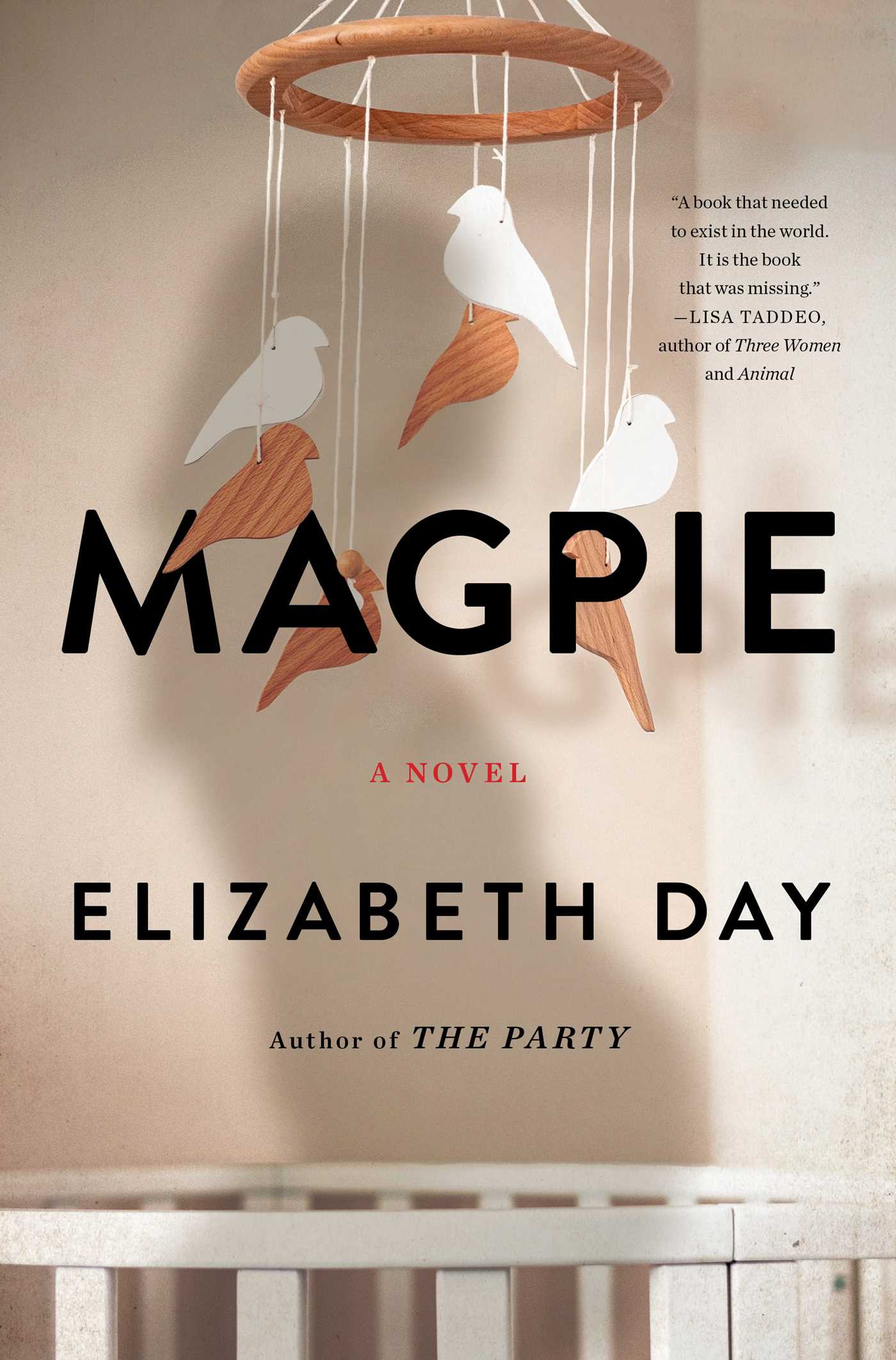
Review: Magpie by Elizabeth Day

She has almost everything. The rest she’ll take.

Single White Female meets The Perfect Nanny in this taut, psychological suspense novel about a perfect couple and their seemingly perfect roommate—that is until she threatens to destroy everything they’ve worked so hard to create.


Marisa and Jake are a perfect couple, and Kate, their new lodger, is the perfect roommate–and not just because her rent payments will give them the income they need to start trying for a baby. Except no one is perfect. Sure, Kate doesn’t seem to care much about personal boundaries and can occasionally seem overly familiar with Jake, but Marisa doesn’t let it concern her. Kate will soon be gone, and it will just be her, Jake, and their future baby.

Conceiving a baby is easier said than done, though, and Jake and Marisa’s perfect relationship is put to the test through months of fertility treatments and false starts. To make matters worse, Kate’s boundary-pushing turns into an all-out obsession–with Jake, with Marisa, and with their future child. Who is this woman? Why does she seem to know everything about Marisa and Jake?

In her quest to find out who Kate really is, Marisa might destroy everything she’s worked so hard to create: her perfect romance, her perfect family, and her perfect self. Jake doesn’t know the half of what Marisa has created and what she stands to lose. Magpie is a tense and twisting novel about mothers and children, envy and possession, and the dangers of getting everything you’ve ever dreamed of. 


I received a digital copy of this book in exchange for an honest review from Edelweiss and Simon & Schuster. All comments are my own.

Exciting premise. And a classic case where I expected there to be a lot of intrigue, and confusion between what was real and what wasn’t. Unfortunately this kind of fell flat for me, and I will divulge why further in this review.

Magpie revolves around Marisa, who has moved in with her new boyfriend Jake, and everything seems perfect with their baby coming around. However, a new lodger comes in, Kate, who is acting quite dubiously, perhaps following Marisa around and being unnecessarily nosy for being a stranger. Just who is this Kate and what does she want with their lives? That is the question that the book attempts to answer through its suspense and intrigue.

Continue reading “Review: Magpie by Elizabeth Day”
2.5 star, YA

Review: Cinder & Glass by Melissa de la Cruz

For this princess, winning the crown is no fairytale.

1682. The king sends out an invitation to all the maidens in France: their presence is requested at a number of balls and events that will be held in honor of the dashing Prince Louis, who must choose a bride. 

Cendrillon de Louvois has more grace, beauty, and charm than anyone else in France. While she was once the darling child of the king’s favorite adviser, her father’s death has turned her into the servant of her stepmother and cruel stepsisters–and at her own chateau, too!

Cendrillon–now called Cinder–manages to evade her stepmother and attend the ball, where she catches the eye of the handsome Prince Louis and his younger brother Auguste.

Even though Cendrillon has an immediate aversion to Louis, and a connection with Auguste, the only way to escape her stepmother is to compete with the other women at court for the Prince’s hand.

Soon, as Cendrillon glows closer to Auguste and dislikes the prince more and more, she will have to decide if she can bear losing the boy she loves in order to leave a life she hates.

Melissa de la Cruz takes a lush, romantic hand to this retold fairy tale classic.


I’m a hugeeee sucker for all things Cinderella. It’s my favorite fairy tale and obviously my favourite one for retellings. So you can imagine my disappointment with how Cinder & Glass turned out, especially with such a gorgeous cover.

This story is set in 1600s France in the court of King Louis XIV. I loved the inspiration to set this fairytale in a historical period instead of some completely reimagined land. The plotline was also intriguing with a competition for the prince’s hand (very reminiscent of The Selection) while secretly falling for the younger prince instead.

With all these elements that just SCREAM at me to like it, it begs the question why I didn’t end up loving this book.

It really all comes down to execution. The set up for a Cinderella tale is quite simple. The protagonist lived a happy life with her family even as her mother died when she was young as her father more than made up for it. The loss of her father and the marriage to her stepmother are the turning points in the story that truly leads to the problems she has to face.

This takes a whole section of the book to even reach, a good quarter of the book setting up the beginning of the Cinderella plot. While I appreciate getting to know a bit about the inner workings of the French court when Cendrillon moved to Versailles, was it really necessary to drag it out that long? Her stepsisters are still fairly horrid and her new stepmother just screams evil in disguise.

Then there’s the pacing. Maybe it’s not my favoured format of reading but it felt very…narrated and detached? As if the author is simply moving through time telling us of what is happening to Cendrillon instead of diving into the depths of emotion she must be facing. I wanted to FEEL and instead it was all rather clinical in execution.

My favourite part of any Cinderella tale is the romance. Yes, I’m a modern day woman who can occasionally swoon at a princely figure coming to help and believe a woman who is being oppressed by someone in power over her. But even that held its own problems here.

First, the competition wasn’t really all that big in this story? It was present but we knew from the start that Cendrillon wasn’t going into it for love as she had met Auguste a year ago and already formed a bit of an attraction to him. Her motivation led to, well, a lack of ambition and focus to win so it wasn’t really that interesting reading about her dates or the other girls she competed with.

The attraction she felt for Auguste wasn’t even consolation as the chemistry was barely there. It felt like they had developed a good friendship in the scary world of court politics but it suddenly blew into the realm of “more-than-friendship” in the blink of an eye, with only the angst that she couldn’t be with him. I wanted to believe in this romance but I really wasn’t feeling it. And that just sucks big time because what’s a Cinderella tale without the love that conquers all?

While I have many complaints about this book, I did enjoy the setting and managed to read this in a day as it’s not too long of a book. The lush descriptions of Versailles made me wish I could go back there again and explore it a little less rushed. It also helped that it’s still a story based on my favourite fairytale. If it was any other, I probably would’ve been tempted to DNF at any time.

I can’t say I recommend this book – something my heart hurts to say because Cinderella! – but it could’ve been worse in some ways. There’s still the fight against the evil stepmother and satisfaction gained when good triumphs over those who oppress and abuse. The idea was there, but perhaps the execution could’ve used some tweaking.

And that cover is to die for so I could just sit here all day staring at it, which would be enough.

Overall Recommendation:

Cinder & Glass fell flat as a Cinderella retelling due to its lack of emotional depth and unhurried pace through the key points we all recognize from the tale. I wanted to love this so bad because I love Cinderella but I couldn’t emotionally connect with any of the characters, even the pain Cendrillon was going through. It’s not a Cinderella story if you don’t even sympathize for her. Or fall in love with her love story.