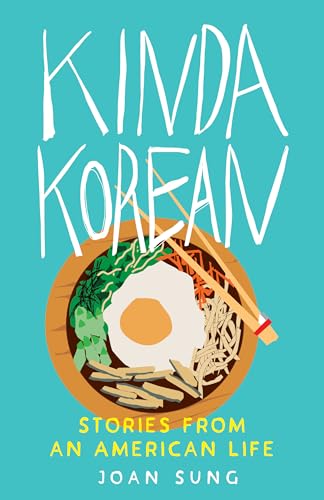
For fans of Michelle Zauner’s Crying in H-Mart and Cathy Park Hong’s Minor Feelings comes a coming-of-age memoir about a daughter of immigrants discovering her Korean American identity while finding it in her heart to forgive her Tiger Mom.
In this courageous memoir of parental love, intergenerational trauma, and perseverance, Joan Sung breaks the generational silence that curses her family. By intentionally overcoming the stereotype that all Asians are quiet, Sung tells her stories of coming-of-age with a Tiger Mom who did not understand American society.
Torn between her two identities as a Korean woman and a first generation American, Sung bares her struggles in an honest and bare confessional. Sifting through her experiences with microaggressions to the over fetishization of Asian women, Sung connects the COVID pandemic with the decades of violence and racism experienced by Asian American communities.
**Kinda Korean: Stories from an American Life comes out February 25, 2025**
CW: sexual assault
Thank you to Sparkpoint Studio for this copy in exchange for an honest review. Note: all quotes are subject to change.
Where shall I begin? I’ve been on hiatus for a long while, barely reading anything last year. So it definitely takes a truly remarkable book to draw me back out of my non-reading shell. And Kinda Korean was the right book to come back into my life at the start of this new year.
Whenever I read a memoir, I struggle with how to rate it, let alone review it. This is someone’s story. Who am I to tell them if their story is “good” or not? Perhaps some people may think certain people’s lives are more worth chronicling, such as your favourite celebrity or a revered leader on the global stage, but don’t we also need to hear stories from the every day person? The kind of person that we can relate to?
This is what makes Joan’s story one that bowled me over in the best way possible, and I hope it’s one that does the same for many others out there. I’ll try to put all my thoughts down in a coherent way. This was not a book for my brain to simply appreciate; it was very much a book that saw into my heart.
I will first preface that I’m not Korean. But I don’t believe we have to be Korean, or even Asian, to feel for Joan. Written in a mostly chronological order and in short chapters catered around specific moments, it was a smooth read although I wouldn’t say it was an easy one. The majority of the story follows her from her youth, setting the scene as an Asian American child growing up in a space that always implicitly (or explicitly) said “you’re not one of us”. To make matters worse, identity can get even more confusing when among others who do look like you, there is still separation based on class and even the coveted double eyelid.
And then there is the matter of family. While my own Asian experiences were thankfully not as Joan experienced, I know well enough people who have had tiger moms. Reading her account of the miscommunication and deep divide between her and her mom was both riveting and heartbreaking. How intergenerational trauma led to years of self-destructive behaviours along with experiences I would never wish on anyone, I just wanted to hug the Joan that was in those pages and never let go.
Okay, so people may ask, what does this have to do with me? Why should I pick up this specific book out of all the ones out there?
My only answer? To understand the Asian diaspora experience more. Whether you are part of the Asian diaspora or not, this is a message for all of us to learn.
How society had constantly told me what it meant to be Asian American, but I was never able to define it myself. How my Korean culture and my Korean family told me I was supposed to be one way, but my American culture told me I was supposed to be something else; I was caught in between. I belonged nowhere.
From the stereotypical fetishization of Asian women to feeling like we don’t belong anywhere, I learned so much within these pages. I highlighted SO many passages because there were so many things I wanted to return to again later. Not every moment had to be deeply personal to have connected with me. But I will say, as a Chinese Canadian reading this, I felt someone had finally worded some of the things embedded deep in my heart for the very first time, like it was okay to take it out of some dark recess and bring it up to the light to examine more closely.
And if I could speak Korean, was that truly the barrier keeping me from feeling “Korean enough”? If I was realistic, my inability to speak Korean would be replaced by another barrier keeping me from feeling Korean. Because that is the thing about the Asian American diasporic experience. We’re always trying to achieve perfection, when it doesn’t really exist.
In Western society, not too many people understand what it’s like to live as the Asian diaspora. I barely know if I’m living it right half the time. But perhaps, that is the beauty of the lesson in Joan’s story, the lesson she learned herself. There is no guidebook for being in this in-between space, therefore, can there be a right or wrong way to go about it with no model to follow? Instead of hiding the pains that are suffered in our strive for perfection, maybe it’s time for a bright light to shine on the dark side of Asian experiences so others may know. Maybe then, shocking events such as post-COVID hate on the Asian community can be better discussed and learned from. Was it really all of a sudden, as some people may have believed, or was it always bubbling just underneath the surface and finally crawling out into broad daylight?
There were so many lessons in Joan’s life that she learned and hence imparted on us as well through her story. So maybe it’s not in the big celebrity experiences alone we need to hear more of, but in the sharing of our everyday experiences that shape us for the better. I know I’ve been changed in some way from it.
My mother always told me the story of the willow and the wind. The willow that fights against the wind ends up breaking apart. But the willow that bends to the will of the wind is the one that survives. Bend to the wind. Heempehrah. Because what else can you do but let go of the things you can’t control?

 Down the Rabbit Hole