
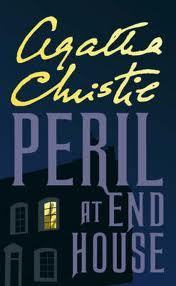
Hercule Poirot is vacationing on the Cornish coast when he meets Nick Buckley. Nick is the young and reckless mistress of End House, an imposing structure perched on the rocky cliffs of St. Loo.
Poirot quickly takes a particular interest in the young woman. Recently, she has narrowly escaped a series of life-threatening accidents. Something tells the Belgian sleuth that these so-called accidents are more than just mere coincidences or a spate of bad luck. Something like a bullet! It seems all too clear to him that someone is trying to do away with poor Nick, but who? And, what is the motive? In his quest for answers, Poirot must delve into the dark history of End House. The deeper he gets into his investigation, the more certain he is that the killer will soon strike again. And, this time, Nick may not escape with her life.

Another Agatha Christie! Hopefully I can make my way through the Hercule Poirots eventually, but maybe not all at once. I saw this at a used bookstore, and I didn’t want to pick it up, but I did end up borrowing it from the library and quickly read through it. I love how short these are, and these writings are honestly timeless. I seriously can’t believe these were written so long ago.
Peril at End House revolves around the mystery of the attempted murder(s) on Nick Buckley, the young heiress of End House. End House is aptly named. Although it is large and vast, it is also run down, and currently a place of unhappiness. The recent attempts on Nick’s life have definitely made the title even more apt. Luckily again, Hercule Poirot is in town, and quickly steps in to prevent Nick’s assassin from claiming her life. Will Poirot be able to save her life and the culprit? Or will he have to give up one to save the other.
Poirot is charming as usual, and we have our perspective once again taking place through the perspective of his friend, rather than he himself. Poirot is a bit insufferable, but I kind of don’t mind that in a detective murder mystery type of story. I find that it gives the story more of a charming air, to lighten the rather serious gravity of a murder situation. Characters are always well done in Agatha Christie books, and so many characters come in and out of the story, yet you can always remember them all as they all have their unique quirks and backstories (of course, all noticed by the famous Hercule Poirot), and this really helps to create an interesting environment and setting for the story to take place.
For the most part the plot was decent. There was really good drive in the suspense as Poirot solves more and more of the mystery, while the biggest key to the puzzle eludes him. Christie always writes really well, in the sense that the “carrot” or big mystery is always dangled in front of you just by the right amount, while little side “treats” are being solved, so that the final goal seems even more enticing. In this case, the big mystery was something I really wanted to know too, and the double whammy of not knowing whether her life would actually be spared (you never know in mystery novels) made it even more exciting.
Unfortunately, where it fell short for me was the ending, where I felt like it wasn’t entirely plausible. It wasn’t impossible or completely off base, but it just wasn’t the direction I was expecting. Or maybe it was that I’ve seen a similar resolution play out better. That being said, Agatha Christie wrote this first, so I wonder if I would have thought differently reading the other book first! I suppose I just wanted a different solution than the one that was proposed, but you can’t always get what you want.
Overall, this was still an easy and quick read, and I always wonder at how these are written so well even for a modern audience (even with some more antiquated terms and references). I will definitely continuing adding more of this series under my belt this year.

 Down the Rabbit Hole
I agree with most of your comments with the exception of Poirot being charming; that he is not. He is an egocentric, tedious bully evidenced by his condescending and nasty behavior and constant comments about Hasting’s inferior mind. Agatha Christie ultimately disliked Poirot, according to her grandson. She referred to him as an “ego-centric creep.” She had to continue with the character because of her publishers, his popularity, and the cash cow the series was. I wonder if making him insufferable and unlikeable in the later novels was her passive way making a statement and displaying her dissatisfaction with the character? The plots of the Poirot series are interesting but the character is not.
LikeLiked by 1 person
You’re totally right about Poirot. I think I meant “charming” more ironically—I don’t take anything he says seriously because he’s clearly an egotistical maniac. Let’s just say I do not read Agatha Christie’s books for Poirot himself, just as a vehicle for whatever cool plot she has cooked up.
LikeLike